


Write For Us + Gaming Guide And Tips
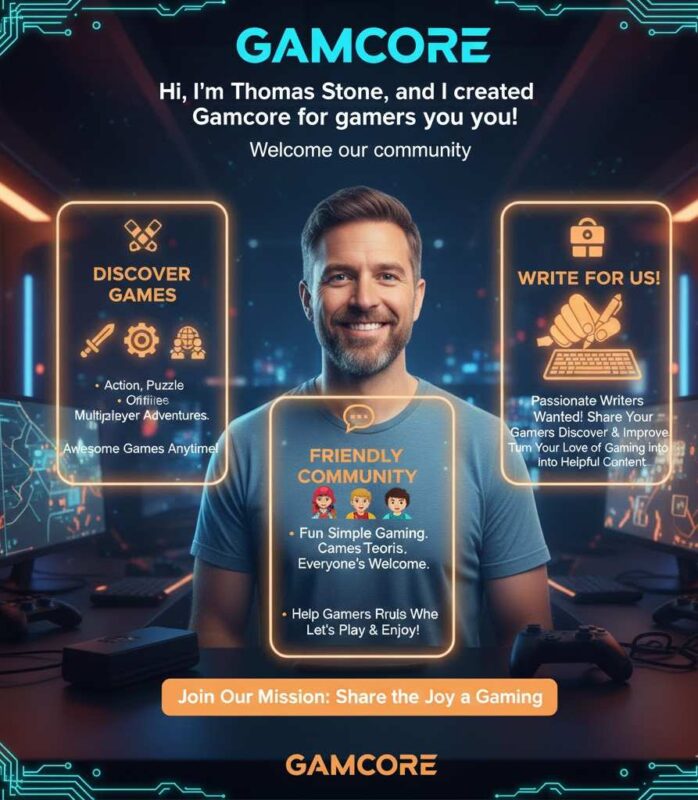
Hi, I’m Thomas Stone, and I created Gamcore for gamers like you! This is the place to find awesome games you can play online anytime, from action and puzzles to multiplayer adventures and beyond. Gamcore is all about fun, simple gaming with a friendly community where everyone’s welcome. Let’s play and enjoy the moment together!
If you love gaming and want to help others discover the joy of playing, you’ve found the right place. We’re always looking for passionate writers who can turn their gaming knowledge into helpful content that actually improves someone’s gaming experience. Whether you’re a seasoned gaming journalist or someone who just really, really loves explaining how to beat that impossible boss level, there’s a spot for you here at Gamcore.
Here’s a quick guide to writing for us and creating gaming content that matters. I’m not going to give you a boring list of corporate guidelines. Instead, I want to share what actually works when creating gaming content that helps real people. I’ve learned a lot over the years running Gamcore, and I want to share that knowledge with you.
Gaming has given me so much joy throughout my life, and I built this platform to create a space where that joy could be shared freely. Every article we publish should carry that same spirit. When you write for Gamcore, you’re not just producing content. You’re becoming part of a community that genuinely cares about helping gamers have better experiences.
Why We Need Writers Who Actually Play Games
Let me be honest with you. The internet is flooded with gaming content written by people who clearly haven’t touched a controller in years. You know the type. Articles that explain how to play Minecraft without mentioning that your first night will be absolutely terrifying if you don’t build shelter. Guides that tell you to “git gud” without actually explaining what that means for a newcomer.
That’s not what we do at Gamcore. We need writers who remember what it felt like to be confused by their first RPG skill tree. Writers who still get excited when they discover a hidden game mechanic after hundreds of hours of play. Writers who understand that gaming isn’t just a hobby but a way people connect, relax, challenge themselves, and find community.

I remember when I first started playing online games back in the early 2000s. The guides available were either written for absolute experts or so basic as to be insulting. There was nothing in between. Nobody was writing for the person who understood the basics but needed help with intermediate concepts. That market gap stuck with me, and it’s one of the reasons I started Gamcore.
When you write for us, I want you to think about your younger self. Think about what would have helped you when you were struggling with a particular game or trying to understand a new genre. That empathy is what separates good gaming content from forgettable fluff.
Real Value of Gaming Knowledge
Your gaming experience has genuine value. Every hour you’ve spent mastering a game, every frustrating death that taught you something new, every moment of triumph when you finally beat that challenge, all of that translates into knowledge that can help others.
I once spent three weeks trying to beat a particular boss in Dark Souls—three weeks of failure, frustration, and nearly throwing my controller through the screen. When I finally won, I immediately wrote down everything I’d learned. That document eventually became one of our most popular guides because it came from real struggle and real solutions.
That’s the kind of authentic experience we’re looking for. You don’t need to be a professional esports player. You don’t need to have played every game ever made. You need genuine experience with the topics you write about and the ability to communicate that experience in a way that helps others.
Understanding Our Audience
Gamcore attracts a diverse audience, but they all share a common trait. They want to have fun playing games without unnecessary complications. Our readers include complete beginners who have just discovered the world of online gaming, casual players looking for something fun to do during their lunch break, parents seeking appropriate games for their kids, and dedicated gamers seeking their next obsession.
When you write for us, keep this diversity in mind. Your article might be read by a teenager who’s been gaming since they could hold a controller and by their grandparent who just got their first smartphone. Both deserve content that respects their intelligence while meeting them where they are.
Topics We Love to Publish at Gamcore
-

How to Improve Reaction Times for Competitive Gaming
-

What the Metaverse Means for Gamers
-

How to Optimize Your PC for a Satisfying Gaming Experience
-

Best Gaming Accessories Every Player Should Have
At Gamcore, we publish a wide range of gaming content, but everything we share has one thing in common. It must genuinely help the reader. We are not interested in filler, hype, or generic opinions. We want content that informs, guides, and respects the fact that gaming is personal.
Below is what we are looking for and what makes each type of content successful.
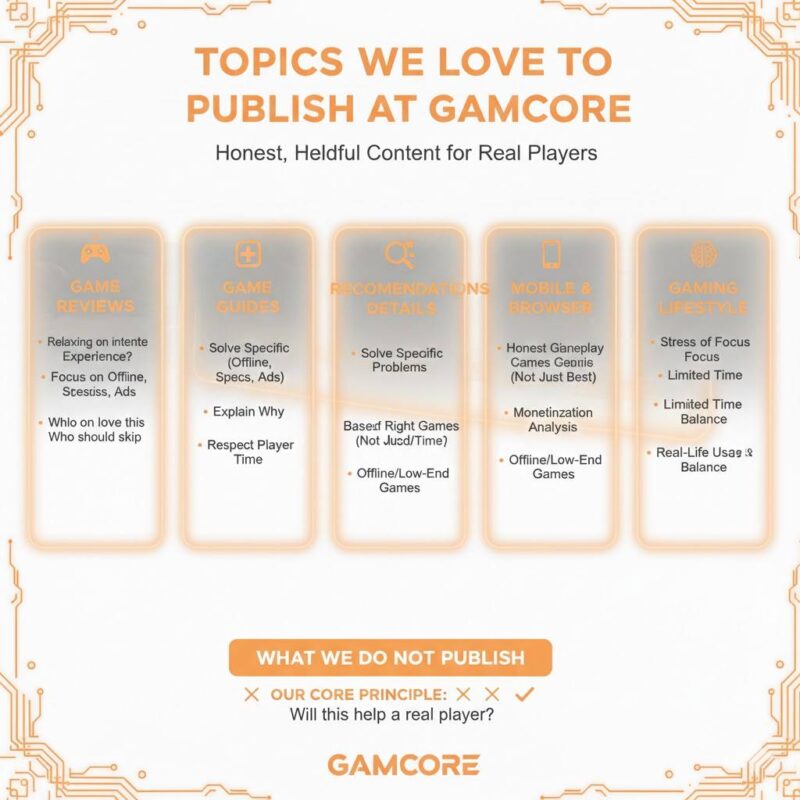
Below is what we are looking for and what makes each type of content successful.
Game Reviews That Actually Help People Decide
Most game reviews fail because they try to be objective about something that is deeply subjective. A game that feels boring or frustrating to one person might be exactly what another player is looking for.
When writing a review for Gamcore, describe the experience instead of assigning a score. Help readers envision what it’s actually like to play the game.
Consider questions like:
- Is the gameplay relaxing or intense?
- Does it work well in short sessions, or does it require long periods of focus?
- Is the game driven by skill, strategy, exploration, or story?
- What type of player will enjoy it, and who should probably skip it?
Honesty matters more than praise or criticism.
I once wrote a review for a puzzle game that I personally found frustrating. Instead of simply criticising it, I explained what made it difficult and noted that players who enjoy slow, methodical brain teasers would probably love it. That review helped the right audience find the game while steering others away. Both groups appreciated the honesty.
Practical Details We Care About
These details matter far more to readers than a numerical rating:
- How long does it take to learn the basics?
- Are there accessibility options such as difficulty settings or colorblind modes?
- Does the game run well on older devices?
- Can it be played offline?
- Are there ads, microtransactions, or pay-to-win mechanics?
- Is it beginner-friendly or aimed at experienced players?
Game Guides That Respect the Player’s Time
We value guides that are clear, accurate, and useful.
Strong guides:
- Solve a specific problem
- Explain why something works, not just what to do
- Avoid unnecessary padding
Good examples include:
- Beginner guides that explain core mechanics clearly
- Tips for difficult levels, bosses, or puzzles
- Progression advice that helps players avoid common mistakes
- Strategy guides for different playstyles
The goal is to help players enjoy the game more, not just finish it faster.
Game Recommendations and Discovery Content
Many players are not searching for the best game. They are searching for the right game.
We welcome recommendation content such as:
- Games for relaxing after work
- Games that work well in short sessions
- Games similar to a specific title
- Games for low-end devices
- Games that can be played offline
- Games suited to beginners or casual players
Each recommendation should explain why the game fits the category.
Mobile and Browser Gaming Content
Gamcore treats mobile and browser games with the same seriousness as PC and console titles.
Good topics include:
- Honest evaluations of mobile gameplay loops
- Monetisation analysis, including ads and microtransactions
- Performance and battery usage
- Touch controls versus controller support
- Browser games that offer depth and replay value
We focus on how these games fit into real-life usage.
Gaming Lifestyle and Player-Focused Content
We also publish content about how gaming fits into everyday life.
This includes topics like:
- How different types of games affect stress and focus
- Choosing games based on limited time
- Casual versus competitive gaming
- Gaming burnout and how to avoid it
- Playing games on older hardware or slow connections
This content works because it puts players first.
What We Do Not Publish
Gamcore avoids:
- Clickbait headlines
- Overhyped lists with no real insight
- Rewritten or copied content
- SEO driven articles with no substance
- Reviews that read like advertisements
If a piece does not help someone make a better gaming decision, it does not belong on Gamcore.
Our Core Principle
Every article should answer one simple question.
Will this help a real player decide, understand, or enjoy a game better?
If the answer is yes, it is a great fit for Gamcore.
How to Write Gaming Content That Actually Helps People
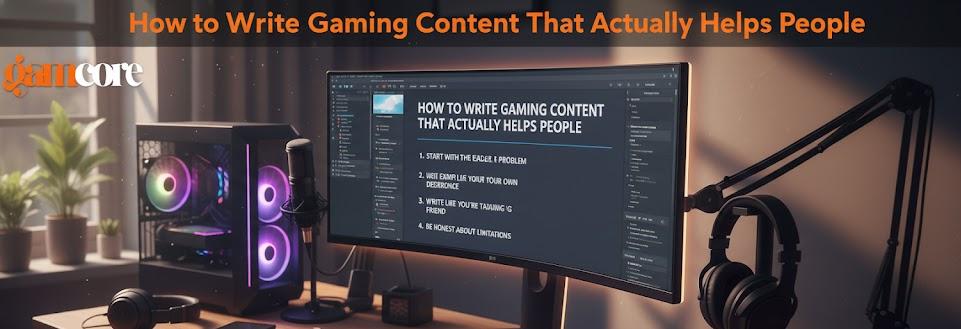
Start With the
Reader’s Problem
Why Are They Here?
- What problem are they solving?
- Acknowledge their frustration
- Give practical advice first
- Value in first paragraphs
Personal Story: Died 47x to a boss. Noticed pattern. Specifics are key! Share failures.
Use Examples
From Experience
Make It Relatable and Credible
- Share personal stories
- Include specific details
- Be honest about mistakes and breakthroughs
- Honesty builds trust
“I struggled with this boss”
“I died to this boss 47 times before I noticed the pattern in its attack timing.”
Write Like
A Friend
Conversational Tone
- Read aloud test
- Use “you” and “I”
- Avoid corporate speak
- Define gaming vocab
“Hey, stuck on that boss? I was too! Try this…”
“I died to this boss 47 times before I finally noticed the attack timing.”
Structure
For Readers
Scan-Friendly Format
- Clear headings
- Short paragraphs
- Important info first
- Define vocabulary
“Inverted Pyramid”
Most important first
Be Honest About
Limitations
Build Real Trust
- Credibility matters most
- Admit what you don’t know
- Keep testimony within experience
- Integrity first
Honest Disclaimer: “Played 10 hrs, early impressions…”
Test Your
Own Advice
Verify Everything Works
- Play the game yourself
- Test every tip you share
- Research player questions
- Watch gameplay videos
Check forums and Reddit. What are players struggling with? Those questions show what to write about.
Real Testing: I read an article about a graphics setting that improved performance. I tested it and saw no difference. Always verify!
Our Core Principle:
✓ Will this help a real player? If YES, write it!
Gamcore
Gaming Content That Actually Helps
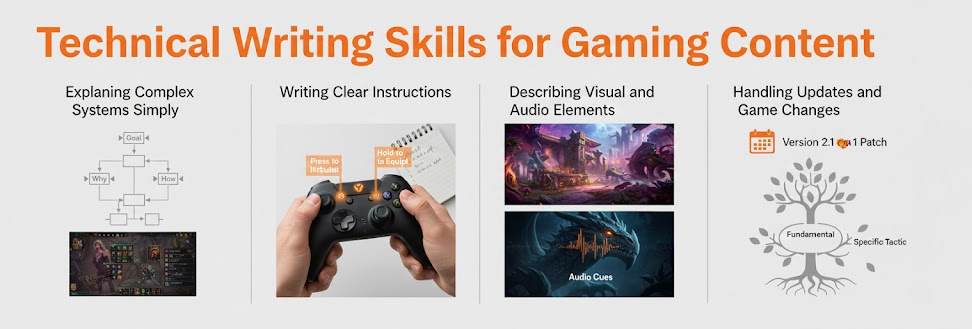
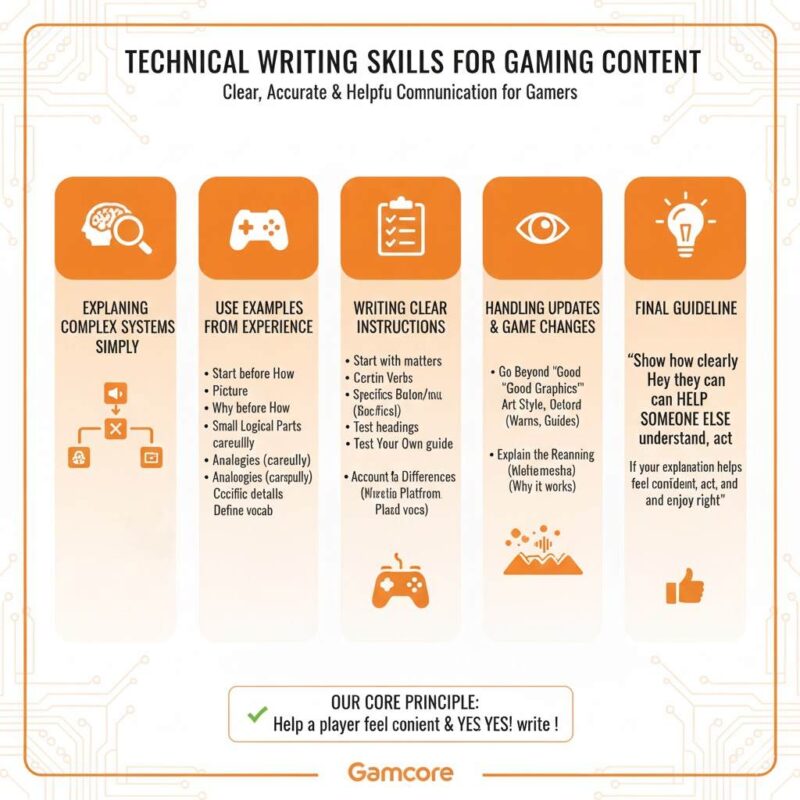
Technical Writing Skills for Gaming Content
Strong gaming content requires more than good grammar and storytelling. Writers must be able to explain systems, guide actions, and describe experiences clearly and accurately. The skills below form the foundation of effective technical gaming writing.
Explaining Complex Systems Simply
Purpose
Help readers understand game systems without overwhelming them.
How to Approach It
Start with the big picture before introducing details. Readers need to understand why a system exists before they care how it works.
For example, when explaining a crafting system:
- First explain what crafting allows players to do
- Then explain why players might want to use it
- Finally, walk through how it works step by step
Best Practices
- Break systems into small, logical parts
- Introduce one concept at a time
- Avoid dumping all mechanics at once
Use Analogies Carefully
Analogies help readers connect unfamiliar systems to real world ideas. A game economy can be compared to supply and demand. Skill trees can be compared to career paths. Make sure comparisons are accurate and do not hide important differences.
Layer Complexity Gradually
Introduce basic ideas first. Allow readers to get comfortable, then add more advanced mechanics. This mirrors how players naturally learn games and makes content easier to follow.
Writing Clear Instructions
Purpose
Ensure readers can successfully follow your instructions while playing.
How to Write Instructions
- Use numbered steps when order matters
- Start each step with a clear action verb
- Be specific about buttons, menus, or settings
Avoid vague phrasing. Readers should never have to guess what to do next.
Testing Your Instructions
Whenever possible, follow your own guide exactly as written while playing the game. This helps reveal missing steps, unclear wording, or assumptions you did not realize you were making.
Account for Differences
Games may vary by platform, control scheme, or update version. When relevant:
- Mention alternative controls
- Note interface changes
- Acknowledge that updates may alter layouts or names
This reassures readers that confusion may come from differences, not from mistakes.
Describing Visual and Audio Elements
Purpose
Help readers imagine what playing the game looks and sounds like.
How to Describe Visuals
Go beyond general phrases like “good graphics.” Describe:
- Art style
- Color palette
- Level of detail
- Animation style
- Overall visual mood
Use concrete language that helps readers form a mental image.
How Audio Affects Gameplay
Discuss sound as part of the experience, not just decoration.
- Does audio warn players of danger?
- Do sound cues guide movement or timing?
- Is music calming, tense, or distracting?
These elements often affect gameplay decisions and enjoyment.
Use Comparisons Thoughtfully
Referencing well known games can save space and improve clarity. Make sure comparisons are accurate and widely understood. Avoid obscure references that confuse more than they help.
Referencing well known games can save space and improve clarity. Make sure comparisons are accurate and widely understood. Avoid obscure references that confuse more than they help.
Handling Updates and Game Changes
Purpose
Keep content useful even as games evolve.
Date and Version Awareness
Always consider when the game content applies.
- Mention the version when mechanics matter
- Date your content clearly
This helps readers judge accuracy and helps editors know when updates are needed.
Focus on Fundamentals
Prioritize information that is unlikely to change.
- Core mechanics
- General strategies
- Design principles
These elements tend to survive patches and balance changes.
Explain the Reasoning Behind Advice
Do not just say what works. Explain why it works. When readers understand the logic behind a strategy, they can adapt it when updates change specific details.
This approach keeps your content relevant longer and builds deeper trust with readers.
Guideline
Good technical gaming writing does not show how much the writer knows. It shows how clearly they can help someone else understand, act, and enjoy a game. If your explanation helps a player feel more confident and informed, you are doing it right.
Thomas Stone
Professional Standards for Gamcore Writers
Beyond writing quality, we expect certain professional standards from everyone who contributes to Gamcore.
Originality and Proper Attribution
Every piece you submit must be your own original work. Plagiarism is an automatic and permanent rejection, no exceptions. This applies to text from other websites, from other writers, and even from AI tools used without proper acknowledgement.
When you reference information from other sources, credit them appropriately. Link to sources when discussing news or citing statistics. If another writer inspired your approach, acknowledge that influence. The gaming writing community is small, and reputation matters.
Build on existing content rather than copying it. If there are already good articles on your topic, your piece should offer something different. A new angle, updated information, deeper analysis, or simply better writing. Redundant content helps nobody.
Accuracy and Fact Checking
Verify facts before including them in your writing. Check game mechanics yourself when possible. Confirm news from official sources. Double-check statistics, dates, and names. Errors damage our credibility and can mislead readers into wasting time or money.
Cite sources that readers can verify. When making claims about game performance, sales figures, or other factual matters, link to where that information came from. This transparency builds trust and helps readers explore further if they want.
If you make a mistake, tell us so we can correct it. Everyone gets things wrong sometimes. What matters is fixing errors quickly and transparently. We’d rather have accurate content than protect anyone’s ego.
Meeting Deadlines and Communication
If you commit to a deadline, meet it. Our editorial calendar depends on receiving content when expected. If circumstances change and you can’t deliver on time, communicate early so we can adjust plans.
Respond to editorial feedback professionally. Our editors will sometimes request changes or ask questions. These interactions should be collaborative and focused on making the content better. Defensiveness about feedback wastes everyone’s time.
Keep us updated on your work. If you encounter problems, discover new information that changes your approach, or have ideas for improving the content, share those proactively. We’re all working toward the same goal.
Respecting Our Community
Everything we publish reflects on the Gamcore community. Content should be welcoming to gamers of all backgrounds, experience levels, and identities. We have zero tolerance for discriminatory content or language.
Avoid punching down at less skilled players or those with less gaming knowledge. Elitism and gatekeeping have no place here. Our mission is to make gaming more accessible and enjoyable for everyone, not to make people feel excluded.
Remember that games are supposed to be fun. Even when writing about serious topics like accessibility, community toxicity, or industry problems, maintain perspective. Gaming is a hobby that brings joy to billions of people, and our content should celebrate that while addressing challenges.
Essential Advice for New Gaming Writers
Before I wrap up, let me share some final thoughts specifically for people who are new to gaming writing.
Your First Article Will Not Be Perfect
Accept this now and save yourself frustration. Writing is a skill that improves with practice. Your tenth article will be better than your first, and your fiftieth will be better still. The goal of your first articles is to learn, not to create masterpieces.
Submit work you’re genuinely proud of, but don’t wait for perfection. Feedback from editors and readers teaches lessons that studying alone cannot. You need real experience with real audiences to develop as a writer.
Rejection Is Part of the Process
Every successful writer has a collection of rejections. A rejection doesn’t mean you’re a bad writer. It means that particular piece wasn’t right for that particular publication at that particular time. Learn what you can from feedback and keep submitting.
Multiple rejections for similar reasons point toward something you need to develop. Single rejections without clear patterns often just mean the fit wasn’t right. Don’t take rejection personally, but do take it as information.
Build Habits, Not Just Skills
Consistent writing practice matters more than occasional bursts of effort. Writers who produce regularly improve faster than those who only write when inspiration strikes. Set a schedule you can maintain and stick to it.
Reading regularly is as important as writing regularly. The more content you consume, the more you absorb about what works. Make reading gaming content and writing gaming content both part of your routine.
Unique Perspective Has Value
Don’t try to sound like other writers or write what you think publications want to hear. Your specific combination of experiences, interests, and communication style is unique. That uniqueness is your greatest asset.
The gaming community benefits from diverse voices. If you feel like you don’t see yourself represented in gaming content, that’s exactly why your perspective matters. Write the content you wish existed.
Resources for Improving Your Gaming Writing
If you want to become a better gaming writer, these resources have helped many people in our community. Master the craft and share your passion with fellow gamers.
Learn from the Best
Discover books that have shaped countless successful gaming writers and content creators.
Join the Community
Connect with fellow writers and receive constructive feedback to accelerate your growth.
Improve Daily
Practice techniques that turn consistent effort into remarkable writing skills.
Browse Resources by Category
On Writing Well
By William Zinsser – teaches clear, effective nonfiction writing. The principles apply directly to gaming content.
- Remove Unnecessary Words
- Write with Confidence
- Clear Communication
- Proven Techniques
The Elements of Style
By Strunk and White – remains essential for understanding grammar and usage. Short, direct, and covers fundamentals.
- Grammar Essentials
- Usage Guidelines
- Quick Reference
- Timeless Advice
Bird by Bird
By Anne Lamott – addresses the psychological challenges of writing. Helps with perfectionism, fear, and writer’s block.
- Overcome Perfectionism
- Beat Writer’s Block
- Handle Fear
- Stay Motivated
Everybody Writes
By Ann Handley – focuses on content creation in digital contexts. Practical advice on headlines, structure, and engaging readers.
- Headline Mastery
- Content Structure
- Online Engagement
- Digital Best Practices
Writing Groups
Find writing groups where you can share work and receive constructive criticism. Feedback from peers accelerates improvement dramatically.
- Share Your Work
- Get Feedback
- Gaming Focus Groups
- Nonfiction Communities
Follow Gaming Writers
Follow gaming writers whose work you admire on social media. Many share insights about their process that can inform your approach.
- Learn Their Process
- Observe Techniques
- Stay Inspired
- Industry Insights
Be a Player First
Participate in gaming communities as a player, not just as a writer researching content. Authentic involvement helps you understand what readers need.
- Authentic Experience
- Understand Readers
- Real Insights
- Community Connection
Write Every Day
Write something every day, even if it’s just a few paragraphs. Consistency matters more than volume. A daily habit of 300 words adds up substantially.
- Build Consistency
- 300 Words Daily
- Create Habits
- Long-term Growth
Rewrite Bad Content
Take a confusing guide you’ve encountered and write a better version. This exercise teaches you to identify problems and practice solutions.
- Identify Problems
- Practice Solutions
- Improve Clarity
- Learn by Doing
Analyse Great Content
When you finish a gaming article that genuinely helped you, go back and study it. What made it effective? How was it structured?
- Study Structure
- Learn Techniques
- Find Patterns
- Adopt Best Practices
Writing for Search Engines
Submissions clearly written to rank for keywords rather than help readers lack genuine usefulness. Write for people first – search engines will recognise that.
- Awkward Keyword Stuffing
- Unnecessary Information
- Lacks Usefulness
- Satisfies Nobody
Assuming Too Much
Many writers forget what it was like to be a beginner. They skip explanations that seem obvious but are essential for their audience.
- Skipping Explanations
- Forgetting Beginners
- Missing Context
- Losing Readers
Copying Existing Content
Submissions that are essentially rewrites of articles available elsewhere add no value. We publish content that offers something unique.
- No Original Value
- Already Available
- Lacks Fresh Angle
- Wastes Everyone’s Time
Neglecting Structure
Good information presented in confusing order fails readers. Outline before you write and know your main points and their order.
- Confusing Order
- No Clear Flow
- Rambling Content
- Hard to Follow
Being Boring
Gaming is fun – gaming content should reflect that. Let your personality come through. Share your enthusiasm and use vivid language.
- Instruction Manual Style
- Academic Tone
- No Personality
- Lacks Enthusiasm
Ready to Start Writing for Gamcore?
The gaming community is waiting for your unique voice and perspective. We can’t wait to see what you create.
Submit Your ArticleFrequently Asked Questions
Get quick answers to common questions about writing for Gamcore
Thank you for visiting Gamcore! We’d love to hear from you. If you have any questions or feedback or need assistance, feel free to reach out using the information below.
1. Do I need professional writing experience?
No professional writing experience is required, but you must demonstrate competent writing. Clear communication, proper grammar, and an engaging style matter more than formal credentials.
2. How much do writers get paid?
Compensation varies based on article type, length, and writer experience. Specific rates are discussed during the acceptance process. New writers start with standard rates and can negotiate higher rates as they build a track record.
3. Can I write about games not on Gamcore?
Absolutely! Our content strategy isn’t limited to games we host. Guides for console exclusives, PC games, mobile games, and general gaming skills are all welcome if they’re relevant to our audience.
4. How long should my article be?
Length should match your topic’s needs. Simple tip lists might be 800 words, comprehensive guides 3,000 words, and deep dives 5,000+ words. Write what your topic requires, then edit ruthlessly for clarity.
5. Can I pitch ideas before writing full articles?
Yes, and this is encouraged for longer or ambitious pieces! Send a brief outline explaining your topic, angle, and why you’re the right person to write it. For pieces under 1,500 words, you can submit completed work directly.
6. What if English is not my first language?
We welcome writers from all backgrounds. What matters is that your writing is clear and readable. Our editors can help polish grammar and phrasing, but you need to bring the gaming knowledge and expertise.
7. How quickly will I hear back about my submission?
We aim to respond to all submissions within 5-7 business days. Longer pieces or pitches may take slightly longer to review. If you haven’t heard back within two weeks, feel free to follow up.
8. What topics are you looking for right now?
We’re always interested in beginner’s guides, strategy tips, game reviews, and gaming culture pieces. Check our content to see what hasn’t been covered recently, and bring your unique expertise.
9. Can I include screenshots or images?
Yes! High-quality screenshots and relevant images strengthen articles. Make sure you have the right to use any images you submit, and provide proper attribution where necessary.
10. Do you accept reprints or previously published work?
We prefer original content that hasn’t been published elsewhere. If you have a previously published piece you’d like to discuss, reach out first. Exclusive content gets priority consideration.
11. How do I improve my chances of acceptance?
Read your work aloud to catch awkward phrasing. Have someone else read it and point out confusion. Focus on being genuinely helpful to readers. Study articles already on Gamcore to understand our style and standards.
12. What happens after my article is accepted?
After acceptance, your article goes through editing for clarity and style. You’ll receive feedback and may be asked for revisions. Once finalized, we’ll schedule publication and handle all formatting and promotion.
Still have a question? 📧 Contact Us — We’re Here to Help
Search Queries to Find More Guest Post Opportunities
If you’re looking to expand your guest posting on gaming websites, using targeted search queries can help you discover sites actively accepting contributions. Here’s a list of effective search terms you can try:
- “write for us” + “gaming”
- “Write for us” games
- “gaming guest post”
- “guest post” + “games”
- “submit guest post” + “gaming”
- “guest post gaming”
- “Gaming write for us”
- “Write for us a game”
- “contribute article” + “video games”
- “submit content” + “gaming site”
- “guest author” + “games”
- “submit article” + “gaming”
- “write for my blog” + “gaming”
- “submit guest article” + “gaming”
- “Send us your content” + “gaming”
- “contribute to our site” + “games”
- “submit post” + “gaming blog”
- “We’re looking for writers” + “games”
- “guest article” + “gaming”
- “game website” + “contribute content”
- “online game publication” + “write for us”
- “mobile gaming” + “guest post”
- “iOS games” + “contribute content”
- “Android gaming” + “write for my site”
- “PC gaming” + “submit article”
- “Mac gaming” + “guest author”
- “Minecraft” + “submit guest article”
- “game site” + “write for us”
- “game reviews” + “write for my site”
- “game previews” + “submit guest article”
- “game guides” + “contribute content”
- “gameplay tips” + “guest author”
- “game videos” + “contribute to our site”
- “competitive gaming” + “write for us”
- “children and gaming” + “submit guest post”
- “cloud gaming” + “submit guest post”
Tip: Mix and match these queries with your specific niche (e.g., VR, indie games, esports) to find even more targeted opportunities. Using quotation marks around exact phrases ensures Google finds pages specifically looking for guest contributors.
Final Thoughts on Writing for Gamcore
Writing about games is a privilege. We get to help people find more joy, overcome frustrations, and connect with communities that share their interests. Never lose sight of that purpose.
The best gaming content comes from genuine enthusiasm combined with genuine helpfulness. When you truly want readers to succeed, and you have knowledge that can help them, that comes through in your writing. No amount of technique can substitute for that authentic motivation.
I built Gamcore because I believe gaming should be accessible and enjoyable for everyone. Every piece of content we publish should serve that mission. If that vision resonates with you, I want to read your work.
Gaming has brought me incredible experiences, lifelong friends, and countless hours of joy. It’s given me challenges that taught me persistence and communities that welcomed me when I felt alone. I know gaming has done similar things for many of you.
Let’s share that with more people. Let’s help newcomers find their first favourite game. Let’s help frustrated players break through obstacles. Let’s help the gaming community become more welcoming and more fun for everyone.
Submit your best work, bring your authentic passion, and join us in making Gamcore a place where gamers help gamers.
Welcome to the team.
Thomas Stone
Founder, Gamcore