
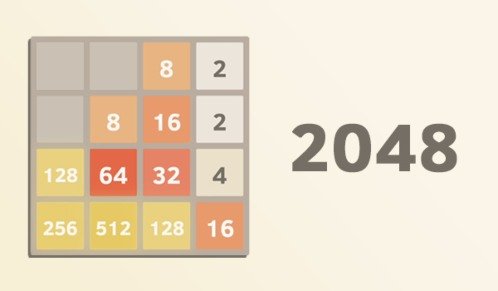


2048
2048 games are number-merging puzzles played on a compact grid. Slide every tile in one direction, combine matching values, keep your largest number in a protected corner, and preserve enough empty space to reach 2048 and continue toward higher tiles.
2048 Games Simple Number Merging Puzzle
2048 games are sliding number puzzles where every move changes the whole board. You move numbered tiles across a four-by-four grid, combine matching values, and try to create the 2048 tile without filling every space. The controls take only a moment to understand, but keeping the board organised requires patience, planning, and the ability to think several moves ahead.
Players who enjoy number merging with a more physical style can also try Chain Cube 2048 3D Merge, where matching cubes collide and combine in a three-dimensional play area.
What Are 2048 Games?
2048 games belong to the sliding tile puzzle genre. The original game was created by Gabriele Cirulli and released in 2014 as an open-source browser project. It uses a four-by-four board containing numbered tiles based on powers of two.
The main objective is to combine equal tiles until a tile marked 2048 appears. Two tiles marked 2 become 4, two 4 tiles become 8, and the pattern continues through 16, 32, 64, 128, and higher values.
Reaching 2048 is considered a win, but the classic version lets players continue while legal moves remain. This allows experienced players to work toward 4096, 8192, or even larger tiles.
The original version of 2048 games provides the classic board, score counter, keyboard controls, and straightforward merging rules.
How 2048 Games Work
The game begins with two numbered tiles placed in empty positions. Most starting tiles contain the number 2, although a 4 can also appear.
Each move shifts every movable tile in one direction:
- Left
- Right
- Up
- Down
When two tiles with the same number meet during a move, they combine into one tile with twice the value. A new tile then appears in one of the empty cells.
The original game code uses a 90 percent chance of generating a 2 tile and a 10 percent chance of generating a 4 tile after a valid move.
A move only counts when at least one tile changes position or merges. If the board is full and no matching neighbours remain, the run ends.
Understanding Tile Merging
Only tiles with the same value can combine. A 16 cannot merge with an 8, even though both are part of the same number sequence.
Each tile normally merges only once during a single move. For example, a row containing 2, 2, 4, and 4 moved to the left becomes 4 and 8. It does not immediately become 12 or combine again during the same movement.
The order of the tiles matters. A row containing 2, 2, 2, and 2 becomes 4 and 4 after one move. Those two new 4 tiles can be combined during a later turn.
This rule prevents long chains from forming automatically. Players must set up each merge through careful positioning.
Controls
Classic 2048 games use keyboard arrows on desktop and swipe gestures on touchscreen devices.
| Action | Desktop Control | Mobile Control |
|---|---|---|
| Move tiles left | Left arrow | Swipe left |
| Move tiles right | Right arrow | Swipe right |
| Move tiles up | Up arrow | Swipe up |
| Move tiles down | Down arrow | Swipe down |
| Restart the board | New Game button | New Game button |
| Continue after 2048 | Keep Playing button | Keep Playing button |
Some browser versions may also support W, A, S, and D. Follow the controls shown beside the version available on Gam-core.
The Main Challenge
The difficult part is not creating the first few merged tiles. It is keeping enough empty space available while the numbers grow.
Every valid move adds another tile. This means the board gradually becomes more crowded unless you create regular merges.
Random swiping may work at the start, but it usually separates useful number chains and fills the middle of the grid. Once large tiles become trapped in different areas, bringing them together becomes difficult.
Strong play depends on board structure. Your largest tile should usually remain in a stable corner, while smaller tiles are arranged around it in descending order.
Keeping the Largest Tile in a Corner
One of the most reliable approaches is to choose a corner and keep your highest tile there.
The lower-left and lower-right corners are popular choices because players can build rows above them while using downward movement to keep tiles together.
Suppose your largest tile is in the lower-left corner. A useful arrangement may look like this:
| 64 | 32 | 16 | 8 |
|---|---|---|---|
| 128 | 64 | 32 | 16 |
| 256 | 128 | 64 | 32 |
| 1024 | 512 | 256 | 128 |
A real game will rarely look this neat, but the general pattern is useful. Large values stay close together, and smaller values feed into them.
Moving away from the protected corner can pull the largest tile out of position. Once a smaller tile appears behind it, returning it to the corner may require several risky moves.
Building a Number Chain
A number chain arranges tiles so each value can merge into the next one.
For example:
2, 2, 4, 8, 16, 32
The two 2 tiles create a 4. That new 4 can later join the existing 4, producing an 8. This continues through the chain.
A good board contains several possible merges rather than one isolated pair. Try to place matching or closely related values near each other.
Avoid scattering high tiles across opposite corners. A 256 in the upper-left and another 256 in the lower-right may take many moves to bring together.
Players who enjoy puzzles based on visual attention rather than number chains can try Find Easy Hidden Differences.
Why Empty Spaces Matter
Empty cells give tiles room to move. A board with six or seven open cells is flexible, while a board with one open cell is close to failure.
Before making a move, check whether it will create a merge. Moving the entire board without combining anything adds a new tile while reducing your available space.
Not every non-merging move is bad. Some are needed to reposition tiles. However, making several such moves in a row can quickly overcrowd the grid.
Try to maintain at least a few empty cells. When space becomes limited, focus on creating small merges before chasing a larger tile.
Useful Strategies for 2048 Games
Choose One Main Direction
Use one direction more often than its opposite. If your largest tile is in the lower-left corner, left and down may become your main movements.
This helps keep the board compressed around the chosen corner.
Avoid the Opposite Move
Moving upward when protecting a bottom corner can break the entire structure. Use the opposite direction only when no safer move remains.
Build Along One Edge
Arrange the largest values along the edge containing your protected corner. Keep the highest number in the corner and place the next highest beside it.
Keep Similar Values Close
A 64 is more useful near another 64 than beside several unrelated small tiles. Matching values should be kept within a few moves of each other.
Plan Before Every Swipe
Look at where all tiles will move, not just the pair you want to combine. A useful merge can still create a bad board if it pulls another large tile out of place.
Protect the Corner Cell
Do not allow a small tile to enter the corner reserved for your largest value. Removing it later may require breaking the whole number chain.
Common Mistakes
Moving in All Four Directions
Using every direction equally makes it difficult to maintain a stable board. The largest tiles often become separated or trapped.
Chasing One Merge
A player may focus on joining two 128 tiles while ignoring the rest of the grid. By the time those tiles meet, the board may be too crowded to continue.
Ignoring Small Tiles
Low-value tiles can block important spaces. Two separate 2 tiles may look harmless, but they can prevent larger values from reaching one another.
Breaking the Main Row
A strong row can collapse after one unnecessary move in the opposite direction. Check whether the desired merge is worth damaging the board structure.
Playing Too Quickly
2048 has no standard turn timer. There is usually no benefit to rushing. A short pause can reveal a safer move.
Scoring
Points are earned whenever two tiles merge. Combining two 8 tiles into a 16 adds 16 points to the score. Combining two 128 tiles adds 256 points.
The score therefore reflects the value of completed merges rather than simply the time spent playing.
Reaching the 2048 tile requires many smaller combinations. A completed 2048 tile represents a long sequence of successful merges, which is why scores are usually much higher by that stage.
The original game’s open-source files explain its movement, tile generation, merging, scoring, and win conditions. Players interested in how the puzzle was built can view the original 2048 source code.
Graphics and Sound
2048 games usually use a clean grid with differently coloured tiles. Low numbers have lighter backgrounds, while larger values use stronger colours that make important tiles easy to recognise.
The design keeps attention on the board rather than adding detailed characters or environments. Each tile shows one number, and movement animations make merges easy to follow.
Sound is often minimal or optional. The puzzle remains fully playable without audio, which makes it suitable for quiet sessions.
For a different puzzle based on movement and simple visual rules, Go Go Magnet uses magnetic forces and environmental obstacles instead of numbered tiles.
Game Modes and Variations
The classic version is a single-player puzzle played on a four-by-four board. Many later versions use the same foundation while changing the theme or layout.
Common variations include:
- Larger five-by-five or six-by-six grids
- Smaller boards with less space
- Three-dimensional merging
- Animal, food, or picture tiles
- Timed challenges
- Daily puzzles
- Undo options
- Alternative target numbers
- Competitive score tables
These versions may feel different, but the main idea usually remains the same: combine matching items while protecting empty space.
Features such as undo buttons, power-ups, alternate modes, and larger boards should only be expected when they are shown in the specific version being played.
Who Should Play 2048 Games?
2048 games suit players who like number puzzles, pattern recognition, quiet strategy, and short browser sessions.
The controls are accessible to beginners because every action uses a single directional move. The deeper strategy appears gradually as players learn to protect corners and build ordered number chains.
The game may also appeal to people who enjoy improving personal scores. A run can last a few minutes or continue much longer when the board is managed well.
Players looking for multiplayer competition, characters, a story, or fast action may find the classic format too simple. Its appeal comes from solving a changing board with limited space.
More casual and puzzle titles are available in the Gam-core games collection.
Honest Strengths and Limitations
| Strengths | Possible Limitations |
|---|---|
| Controls are easy to understand | Strong strategy takes time to develop |
| Runs fit short or long play sessions | Repeated boards may feel similar |
| Every move creates a meaningful change | New tile placement includes randomness |
| Works well with keyboards and touchscreens | One poor move can damage a long run |
| No complicated story or tutorial is required | Classic mode has limited visual variety |
| Encourages planning and pattern recognition | Players seeking action may find it slow |
| Allows continued play beyond 2048 | Reaching very high tiles requires patience |
Tips Before You Start
Pick a Corner Immediately
Choose where your largest tile will stay before the board becomes busy. Changing corners during a run is difficult.
Use Three Directions When Possible
Build your strategy around three directions and avoid the movement that pulls tiles away from your protected edge.
Check the Whole Board
Do not watch only the largest numbers. Small tiles often decide whether future merges remain possible.
Keep the Board Compressed
Move tiles toward the selected edge so empty spaces remain together rather than being scattered.
Create Multiple Merge Options
A board with several matching pairs is safer than one depending on a single large merge.
Pause Before Breaking a Row
When a move disrupts your ordered edge, check whether another direction can create the same result safely.
Recover Space Early
Do not wait until only one empty cell remains. Merge smaller tiles while several movement options are still available.
Continue After Reaching 2048
When the version allows it, continuing the run helps you practise handling larger tiles and tighter board conditions.
2048 Games Information
| Detail | Information |
|---|---|
| Game title | 2048 Games |
| Original creator | Gabriele Cirulli |
| Original release | 2014 |
| Genre | Sliding tile and number puzzle |
| Main mode | Single-player |
| Classic board | Four-by-four grid |
| Main objective | Create the 2048 tile |
| Controls | Arrow keys or swipe gestures |
| Starting tiles | Usually 2 or 4 |
| Platforms | Web browsers and mobile devices |
| Difficulty | Simple controls with challenging strategy |
The official mobile editions are also available through the 2048 Android app and the 2048 iPhone and iPad app.
Frequently Asked Questions
What are 2048 games?
2048 games are number-merging puzzles played by sliding tiles across a grid. Matching values combine into larger numbers until the player creates a 2048 tile or runs out of legal moves.
How do I play 2048 games?
Use the arrow keys on a computer or swipe on a touchscreen. Every tile moves in the selected direction, and matching tiles combine when they meet.
Is 2048 a multiplayer game?
The original 2048 is a single-player game. Some later variations may include leaderboards or competitive modes.
Who created the original 2048?
The original game was created by Gabriele Cirulli and released as an open-source browser game in 2014.
What happens after reaching the 2048 tile?
The classic version announces that the target has been reached and gives the player an option to continue. The run can carry on until no legal moves remain.
Can two different numbers merge?
No. Only equal tiles can merge. Two 16 tiles create 32, but a 16 and an 8 cannot combine.
Why does a new tile appear after every move?
A new tile increases pressure and gradually fills the board. It appears after a valid move that changes the grid.
Can I undo a move?
The classic version does not include a standard undo option. Some newer or modified versions may provide one.
Is there a guaranteed way to win?
No simple strategy guarantees every run because new tile locations include randomness. Keeping the largest tile in one corner and maintaining an ordered edge can improve consistency.
Can I play beyond 2048?
Yes. The classic game lets players continue after creating 2048, provided legal moves remain.





Reviews
There are no reviews yet.