
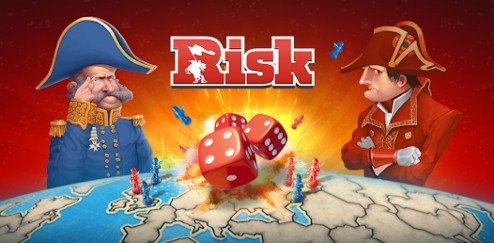

Risk Game
Risk Game is a classic territory strategy experience built around deployment, dice battles, continent control, and careful defence. Build armies, attack neighbouring regions, earn reinforcement cards, and decide when to expand or protect your borders.
Risk Game Global Strategy and Territory Control
Risk Game is a turn-based strategy game about controlling territories, building armies, and deciding when a battle is worth taking. The world map may look open at first, but borders quickly become crowded as players compete for continents and valuable positions.
Luck affects individual battles because combat uses dice, but strong planning matters across the full match. A player who attacks everywhere often becomes weaker than someone who protects borders and waits for the right moment.
Players who enjoy slower games built around planning may also like Master Chess, where every move can change the shape of the match.
What Is Risk Game?
Risk Game is based on the classic board game of global domination. Players control armies placed across a world map divided into territories and continents. The traditional board contains 42 territories grouped into six continents.
The usual goal is to take control of the map by defeating rival armies and capturing their territories. Some versions also include shorter objectives, secret missions, capital-based rules, or custom victory conditions.
A normal turn is divided into three main phases:
- Deploy new troops
- Attack neighbouring territories
- Fortify a position
The official digital version follows these main phases while offering optional rule changes and additional maps.
Players looking for the traditional setup and official instructions can check the Risk Game rule page from Hasbro.
How Risk Game Works
Every player begins with a group of territories and armies. The exact starting setup depends on the selected version, player count, and game rules.
At the beginning of your turn, you receive reinforcements based partly on how many territories you control. Controlling an entire continent can provide additional armies each turn.
You then choose whether to attack a neighbouring enemy territory. Territories must normally share a border or have a marked connection before armies can move between them.
After finishing your attacks, you can usually move troops between connected territories during the fortify phase. This final move is often used to strengthen a weak border or prepare for the next turn.
Deploying Reinforcements
Deployment may look like the quietest part of Risk Game, but it often decides whether your turn succeeds.
Placing every new army on one border creates a strong attacking point. Spreading troops across several areas gives better protection but may leave you without enough strength to capture anything important.
Before deploying, check three things:
- Which borders can be attacked immediately
- Which continent bonus is at risk
- Which opponent appears ready to expand
New players often place armies where they want to attack without checking their weakest territory. This can lead to a successful battle followed by the loss of an entire region during the next turn.
A safer approach is to protect important borders first and then use the remaining troops for expansion.
Attacking Territories
To attack, select one of your territories that contains more than one army and choose an adjacent enemy territory.
The attacking and defending players roll dice. The highest results are compared, and armies are removed according to the outcome. Tied dice favour the defender in the official rules.
An attacker can normally roll up to three dice when enough armies are available. A defender can normally roll up to two. At least one army must remain behind in the attacking territory.
This means a large army does not guarantee a clean victory. Poor dice results can reduce a strong force quickly.
The most important decision is not always whether you can win. It is whether the territory will still be useful after the battle.
Capturing a position with only one army left may make it easy for the next player to take it from you.
Knowing When to Stop Attacking
Risk Game rewards expansion, but attacking for too long can damage an otherwise strong position.
A common mistake happens after several good dice rolls. The player continues forward, captures more territory, and ends the turn with a long border that cannot be defended.
A better turn may involve taking one important territory and stopping.
Useful reasons to end an attack include:
- You have completed a continent
- Your remaining army is becoming too small
- The next territory does not improve your position
- Another opponent would benefit from your weakened forces
- Your new borders are becoming difficult to protect
Stopping early can feel unsatisfying, especially when an enemy territory looks easy to capture. However, keeping a strong army together can be more valuable than adding one weak territory.
Controlling Continents
Continents provide additional reinforcements when one player controls every territory within them.
Smaller continents are often easier to complete, but they may have obvious entry points that attract attention. Larger continents offer stronger bonuses but require more territories and borders to protect.
Holding a continent is different from capturing it.
You may complete a region during your turn and lose one border territory immediately afterward. This removes the bonus before your next deployment phase.
Before attempting continent control, count the borders that connect the region to enemy territory. A smaller bonus with two protected entry points may be more useful than a larger bonus surrounded by rivals.
Players who like board control and defensive positioning can also try Backgammon Gold, where blocking routes is just as important as moving forward.
Cards and Additional Armies
In standard Risk rules, capturing at least one territory during a turn can earn a card. Sets of cards can later be exchanged for additional troops.
These reinforcements can change the balance of a match. A player who appears weak may suddenly place a large army and break through an important border.
Do not judge an opponent only by the armies currently visible on the map. Their card count may suggest that a larger turn is approaching.
Cards also create a reason to capture at least one territory without continuing a long attack. A small, controlled victory may provide a card while keeping most of your army protected.
Fortifying Your Position
Fortification happens after attacking. It allows you to move armies from one controlled territory to another eligible position.
This phase should not be treated as an unimportant final click. A good fortify move prepares your defence before the next player begins.
Move troops away from safe inner territories and toward exposed borders. Leaving many armies in a position that cannot be attacked wastes part of your strength.
However, do not empty every inner territory without checking the map. Some versions require connected paths for troop movement, and a broken route may limit future fortification.
Your strongest army should usually sit where it can defend an important border or support the next planned attack.
Reading Other Players
Risk Game is partly about the map and partly about understanding what other players are trying to do.
Watch where an opponent places reinforcements. A growing army beside your border is rarely accidental.
Also notice which territories they avoid attacking. They may be protecting an informal agreement, preparing for a different continent, or waiting for two rivals to weaken each other.
In multiplayer matches, the strongest-looking player often becomes the main target. Expanding too quickly can therefore create attention before you are ready to defend yourself.
A balanced position can sometimes be safer than obvious map control.
For another competitive strategy game where reading an opponent matters, Clash Royale uses shorter matches but still rewards timing, resource control, and careful pressure.
What Makes Risk Game Interesting?
Risk Game combines long-term planning with uncertain battles.
You can choose the right target, gather a stronger army, and still lose more troops than expected. The challenge is building a plan that can survive an unlucky result.
The map also creates natural tension between players. Two rivals may avoid fighting for several turns because attacking would weaken both of them. That temporary peace can end as soon as one player sees an opening.
A match can change quickly when:
- A continent bonus is broken
- A player exchanges cards for reinforcements
- One opponent is eliminated
- A large army loses several dice rolls
- A quiet player begins expanding
These shifts make awareness important. Focusing only on your own corner of the map can leave you unprepared for a larger threat.
Main Risk Game Features
- World map strategy: Players compete for connected territories across several continents.
- Turn-based decisions: Each turn provides time to deploy, attack, and fortify.
- Dice-based combat: Battles include uncertainty, even when one army is larger.
- Territory reinforcements: Owning more land increases the number of troops available.
- Continent bonuses: Full regional control provides additional armies.
- Card rewards: Successful turns can provide cards that are exchanged for reinforcements.
- Defensive planning: Strong borders and useful troop placement matter as much as attacking.
- Different victory rules: Some digital editions include classic domination, capitals, missions, and custom settings.
- Solo and multiplayer options: The official digital game supports computer opponents and matches with other players.
Controls and Interface
Digital Risk versions normally use a mouse, trackpad, or touchscreen.
| Action | Typical Control |
|---|---|
| Select a territory | Click or tap it |
| Place reinforcements | Choose a territory and troop amount |
| Start an attack | Select your territory and a neighbouring enemy |
| Roll or blitz | Choose the available battle option |
| Move captured troops | Select the number to transfer |
| Fortify | Choose the starting and destination territories |
| End a phase | Select the phase or continue button |
| Inspect cards | Open the card panel |
The exact buttons may differ between browser, desktop, and mobile versions. The official digital tutorial provides guided instructions on a map based on the classic layout.
Graphics and Sound
Risk Game usually presents the action through a clear world map with coloured territories, army counters, border lines, and continent labels.
Good visual design matters because players need to recognise ownership and troop numbers quickly. A crowded interface can make it difficult to notice a weak border or connected attack route.
Digital versions may add battle animations, dice effects, map themes, and sound cues when territories change control.
The presentation is less important than map clarity. Risk is mainly about decisions, so players should be able to inspect the entire board without losing track of troop positions.
Learning Curve
The turn structure is easy to understand after a few rounds. Place armies, attack a neighbouring territory, and move troops before ending the turn.
The deeper challenge comes from managing several problems at once.
You need to consider troop numbers, dice risk, cards, continent bonuses, border length, turn order, and the likely plans of other players.
Beginners often focus on capturing land. More experienced players pay closer attention to whether that land can be held.
Players learning turn-based board strategy may also enjoy Elo Board Games for Two, which includes classic games based on patient decision-making.
Honest Strengths and Limitations
| Strengths | Possible Limitations |
|---|---|
| Simple turn structure | Full matches can take time |
| Strong mix of attack and defence | Dice can change a carefully planned battle |
| Map position creates meaningful choices | Early mistakes may affect many later turns |
| Multiplayer matches encourage negotiation and observation | Some players may dislike temporary alliances |
| Different objectives can change the pace | Rules can vary between editions |
| Computer opponents allow solo practice | AI behaviour may feel less flexible than human play |
| Every match develops differently | Large multiplayer boards can become slow |
Beginner Tips for Risk Game
Protect Borders Instead of Every Territory
Inner territories are usually safe when surrounded by land you already control. Move more armies toward positions that touch enemy regions.
Avoid Fighting on Too Many Fronts
Expanding in several directions creates a long border. Choose one practical target and keep other areas stable.
Capture One Territory for a Card
When card rules are active, one successful capture may be enough for the turn. You do not need to continue attacking after earning it.
Watch the Turn Order
A weak territory may survive one opponent but not three. Check how many players will act before your next turn.
Do Not Complete a Continent Too Early
Taking a continent can make you look dangerous. Make sure you can defend it before claiming the final territory.
Keep a Reserve Army
Do not place every soldier on the leading edge of one attack. A reserve can protect a damaged border or support another area.
Count Enemy Cards
A player holding several cards may be close to receiving a large reinforcement boost. Prepare before they begin their next turn.
Use Dice Risk Carefully
A larger army improves your chances but does not remove uncertainty. Avoid battles where one bad result would destroy your whole position.
Fortify With a Purpose
Move troops toward a border, a future attack route, or a threatened continent. Do not move armies simply because the option is available.
Risk Game Information
| Detail | Information |
|---|---|
| Game title | Risk Game |
| Genre | Turn-based strategy and board game |
| Publisher of the classic game | Hasbro |
| Main objective | Control territories and defeat opponents |
| Traditional map | 42 territories across six continents |
| Main phases | Deploy, attack, and fortify |
| Combat system | Dice-based battles |
| Common player options | Solo, local, and online depending on version |
| Controls | Mouse, touchscreen, or controller depending on platform |
| Difficulty | Easy rules with deeper long-term strategy |
Frequently Asked Questions
What type of game is Risk Game?
Risk Game is a turn-based territory strategy game. Players deploy armies, attack neighbouring territories, and protect their borders while trying to complete the selected objective.
How do battles work in Risk Game?
The attacker and defender roll dice based on the number of armies involved. The highest dice are compared, and the lower result loses an army. Ties favour the defender under the official rules.
How many territories are on the classic Risk map?
The classic map contains 42 territories divided across six continents.
What are the three main turn phases?
The main phases are deploy, attack, and fortify. Players receive troops, choose any attacks, and then move armies to strengthen their position.
Do I have to attack every turn?
No. Players must deploy their reinforcements, but attacking and fortifying can be optional depending on the rules being used.
Can Risk Game be played alone?
Official digital versions provide single-player games against computer-controlled opponents. Some browser versions may offer different modes.
Does Risk Game have multiplayer?
Yes. The classic board game supports multiple players, and the official digital adaptation includes online and friend-based multiplayer options.
Is Risk Game based only on luck?
No. Dice affect individual battles, but troop placement, border control, card timing, target choice, and defensive planning strongly affect the full match.
What happens when I control a continent?
Controlling every territory in a continent normally provides bonus reinforcements at the beginning of your turn. Larger continents generally provide larger bonuses.
Is Risk Game difficult for beginners?
The basic phases are straightforward, but map control and multiplayer strategy take time to learn. Starting against computer opponents can help new players understand the flow.




Reviews
There are no reviews yet.