
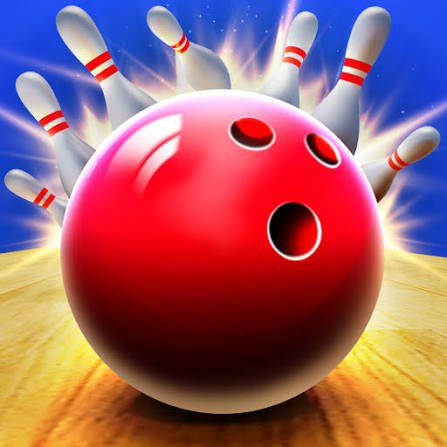


Bowling
Bowling is a browser sports game where you aim, set power, roll the ball, and try to clear ten pins. Learn the pocket, control spin, convert difficult spares, complete each frame, and work toward a higher score.
Bowling
Bowling places you at the start of a polished lane with one ball, ten pins, and two attempts to clear everything standing at the far end. The basic action is simple: choose a starting position, aim the ball, set the power, and release it toward the pins.
The challenge comes from the small differences between throws. A ball sent directly through the centre may leave pins standing on both sides. Too much spin can carry it away from the pocket, while weak power may reduce the force transferred through the pin formation.
Players who enjoy sports games based on measured direction and power can also try Mini Golf, where each course rewards careful aim rather than maximum strength.
What the Bowling Game Is About
Bowling is a browser sports game based on ten-pin scoring, ball direction, release timing, power, and optional spin control.
A standard frame begins with ten pins arranged in a triangular formation. Your objective is to knock down as many as possible with the first ball. When pins remain, you normally receive a second attempt to clear them.
The common gameplay may include:
- Choosing a starting position
- Aiming toward the pins
- Setting shot power
- Releasing the ball
- Adding left or right spin
- Scoring strikes and spares
- Completing several frames
- Competing against the computer
- Sharing a device in supported modes
- Improving a personal best score
The exact controls and match length depend on the version hosted on Gam-core. Some editions use a complete ten-frame game, while others provide a shorter five-frame or score-challenge format.
Use the instructions inside the game as the correct guide for its available modes.
How Bowling Gameplay Feels
A bowling turn usually begins slowly.
You have time to study the pin formation, move the ball into a starting position, and prepare the direction. Once the ball is released, you watch it travel down the lane and see how the pins react.
The first throw in a frame is normally aimed at the full rack. A clean impact can send pins into one another and clear the lane. A less accurate attempt may leave one pin, a small group, or a difficult split.
The second attempt creates a different problem. Instead of hitting a large formation, you need to target the exact pins that remain.
This gives every frame two possible challenges:
- Create a strong first impact.
- Clean up the remaining pins when the strike is missed.
A high score depends on both parts. Strikes provide the greatest scoring potential, but reliable spare conversion prevents weak frames from lowering the total.
Bowling Controls
The control system varies between browser editions.
Mouse Controls
A common mouse-based game may use:
- Move the mouse: Choose the ball’s starting position
- Click and drag: Set the direction
- Release the mouse button: Roll the ball
- Move after release: Apply spin in supported versions
- Power meter click: Stop the indicator at the chosen strength
Touchscreen Controls
Mobile versions may use:
- Drag the ball left or right
- Swipe forward to roll
- Curve the swipe to apply spin
- Release after choosing power
- Tap menu buttons to change modes
Keyboard Controls
Some versions may use:
- Left and Right Arrows: Move or aim
- Up Arrow or Spacebar: Begin the throw
- Spacebar: Stop a power or accuracy meter
- A and D: Add spin
- Esc: Pause or open the menu
Test one ordinary throw before trying to score perfectly. Learn whether the game measures swipe speed, uses a power meter, or lets you steer after release.
Start With a Consistent Position
Moving the ball randomly before every throw makes it difficult to learn from the result.
Choose a repeatable starting area and use it for several attempts.
A consistent position helps you understand:
- How the ball travels
- Whether it naturally curves
- How much power is being used
- Which pin receives the first contact
- How small aiming changes affect the result
When a throw nearly clears the rack, adjust the direction slightly instead of moving to the opposite side of the lane.
Consistency turns each result into useful information.
Aim for the Pocket
In ten-pin bowling, the pocket is the area between the head pin and the pin immediately beside it.
A right-handed-style delivery commonly approaches the space between pins 1 and 3. A left-handed-style path commonly approaches between pins 1 and 2.
In a browser game, this angled contact can help spread force through more of the pin formation.
A direct hit on the front centre may sometimes leave pins standing at the corners because the energy moves backward without spreading widely enough.
To find the pocket:
- Begin from a stable starting position.
- Aim slightly away from the centre.
- Use a controlled amount of spin when supported.
- Watch which pin the ball reaches first.
- Make a small adjustment on the next frame.
The exact lane physics vary between games, so use the visible result rather than assuming every edition behaves realistically.
Control the Power
More power can create stronger pin movement, but maximum strength does not automatically produce a strike.
Excessive power may:
- Reduce accuracy
- Make a timing meter harder to stop
- Magnify a poor direction
- Carry the ball beyond the intended path
- Make spin more difficult to control
Moderate power is often easier while learning.
Increase it after you can send the ball repeatedly toward the same target. Accuracy gives the pin impact a useful starting point, while power supports the reaction afterward.
A strong throw that misses the pocket can score less than a controlled ball that contacts the correct area.
Using Spin
Some Bowling games allow you to curve the ball through left or right spin.
Spin can help the ball enter the pocket from an angle. It can also move the ball away from the pins when applied without enough control.
Use a small amount first.
Watch:
- Where the curve begins
- How far the ball moves sideways
- Whether lane position changes the effect
- How power affects the curve
- Which pin receives the first contact
Do not change aim, power, and spin dramatically after one miss.
When the ball passes slightly to one side, adjust only one part of the throw. Small corrections make the result easier to understand.
Straight Shots
A straight shot travels toward the selected direction with little or no curve.
It is useful for:
- Learning the controls
- Targeting a single remaining pin
- Completing an easy spare
- Playing a version without spin
- Building consistent aim
- Avoiding an exaggerated hook
Straight shots may not always produce the strongest strike angle, but they provide predictable movement.
Beginners should learn to hit a chosen pin consistently before adding a large curve.
How to Score a Strike
A strike occurs when all ten pins fall from the first ball of a frame.
It is marked with an X on a traditional scoreboard.
A strike is valuable because its score includes:
- The ten pins knocked down
- The pins from your next throw
- The pins from the throw after that
This means consecutive strikes can build the score quickly.
To improve strike chances:
- Use a repeatable starting position
- Aim for a pocket rather than the centre
- Keep power controlled
- Add only manageable spin
- Watch the first pin contact
- Make small adjustments between frames
Do not become frustrated when a good-looking throw leaves one pin. Pin reactions contain some variation, especially in arcade-style physics.
How to Score a Spare
A spare occurs when all ten pins are cleared using both throws in the frame.
It is marked with a slash on a traditional scoreboard.
The spare score includes:
- Ten pins from the completed frame
- The number of pins knocked down by the next throw
Spare conversion is one of the most important parts of building a reliable score.
When pins remain:
- Ignore the strike route used on the first ball.
- Identify the exact remaining formation.
- Move the starting position when needed.
- Aim directly at the most useful pin.
- Reduce spin for single-pin attempts.
- Use enough power without sacrificing accuracy.
A player who converts regular spares can score well even without many strikes.
Clearing a Single Pin
One remaining pin should be approached as an accuracy challenge.
Move the ball so the target sits on a clear line down the lane.
Use:
- A direct aim
- Moderate power
- Little spin
- A stable release
- Small corrections only
Do not use the same curved strike throw when it moves away from the remaining pin.
The goal is no longer to create a large chain reaction. It is simply to contact one precise target.
Clearing Multiple Pins
When two or more pins remain close together, aim at the front or most central pin in the group.
The ball and falling pins may clear the others.
When the pins are separated, decide which route provides the best chance of completing the spare.
A small connected group is normally easier than pins standing on opposite sides of the lane.
Do not aim between two separated pins unless the ball is wide enough to contact both. Targeting one pin may be the safer way to protect part of the frame score.
Understanding Splits
A split occurs when the head pin has fallen and separated pins remain with a gap between them.
Some splits are difficult because the ball cannot contact every standing pin directly.
In a simplified browser game, a successful conversion may require one pin to slide or deflect into another.
When facing a split:
- Identify the smaller gap
- Choose which pin should be contacted first
- Consider whether angle or spin can create sideways movement
- Use controlled power
- Accept that partial pinfall may be the practical result
Do not use random maximum-power throws.
A deliberate attempt gives you a better chance of clearing at least part of the formation.
Understanding Bowling Frames
A traditional bowling game contains ten frames.
During frames one through nine:
- You receive up to two throws
- A strike ends the frame immediately
- A spare uses both throws
- An open frame leaves pins standing after the second ball
The tenth frame has bonus opportunities.
A strike in the final frame normally provides two extra throws. A spare provides one extra throw so the bonus can be calculated.
Some browser versions shorten the match or simplify the final frame.
Check the scoreboard to see how many frames are included.
Bowling Scoring Explained
Basic pin scoring is simple: each fallen pin counts as one point.
Strikes and spares add bonuses.
Open Frame
The frame score equals the number of pins knocked down across two attempts.
Spare
The frame scores ten plus the number of pins from the next throw.
Strike
The frame scores ten plus the number of pins from the next two throws.
Perfect Game
Twelve consecutive strikes in a regulation ten-frame game produce the maximum score of 300.
Browser games may show the total automatically, so you do not need to calculate each bonus during play.
Understanding the system still explains why consecutive strikes matter more than isolated ones.
Reading the Scoreboard
A bowling scoreboard normally displays:
- Current frame
- First throw result
- Second throw result
- Strikes
- Spares
- Running total
- Current player
- Remaining frames
Bonus scoring can make the running total appear delayed.
For example, the complete value of a strike cannot be calculated until two more throws have happened.
Do not assume the game failed to add points when a frame total remains blank temporarily.
Improving Your First Throw
The first throw should create either a strike or an easy spare opportunity.
A good first ball:
- Reaches the pocket
- Avoids the gutter
- Uses repeatable power
- Keeps the ball on a predictable path
- Spreads pin movement across the rack
- Leaves a manageable formation when it misses
Do not chase small visual variations in pin movement by changing everything after every frame.
When the ball reaches the intended area consistently, keep the setup and allow the game’s pin physics to work.
Recovering After a Gutter Ball
A gutter ball leaves the lane and scores zero.
It usually happens because:
- The aim was too wide
- Spin was excessive
- The swipe curved unexpectedly
- The release timing was poor
- The starting position was too close to an edge
For the second throw:
- Move farther from the gutter.
- Reduce spin.
- Use a straighter direction.
- Keep the power moderate.
- Focus on returning the ball to the pin area.
Do not attempt another extreme correction. The immediate goal is to score from the remaining attempt.
Common Bowling Mistakes
The most common mistake is aiming directly at the centre of the head pin on every first throw.
Another mistake is using maximum power before learning the direction.
Players may also apply too much spin, causing the ball to move past the pocket or enter the gutter.
Changing the complete setup after every result removes the benefit of repetition.
Some players use the same strike route for spare attempts even when only one pin remains.
Ignoring the scoreboard can cause confusion about frames and bonus throws.
The final common mistake is rushing the release after one poor result. A new frame should begin with the same calm setup as the first.
How to Improve at Bowling
Start with accuracy before trying to score repeated strikes.
A useful learning order is:
- Understand the release control.
- Keep every ball out of the gutter.
- Use one starting position.
- Build consistent power.
- Learn the pocket angle.
- Add small amounts of spin.
- Practise single-pin spares.
- Learn common remaining formations.
- Read the scoreboard.
- Work toward consecutive strikes.
Improvement appears through tighter results.
When the ball repeatedly reaches the same group of pins, you can make a meaningful adjustment. Widely different throws provide less useful information.
Training and Practice Modes
Some Bowling versions include a practice mode without a full match score.
Practice can help you test:
- Starting positions
- Aim
- Power
- Spin
- Pocket entry
- Spare routes
- Different ball choices
Use practice to repeat one setup several times.
A single strike does not prove that the approach is reliable. Several similar deliveries reveal whether the chosen line can be repeated.
Not every browser version includes practice, so check the menu before describing it as available.
Single Player Matches
A single-player game may ask you to complete ten frames and improve your personal score.
Other editions provide an AI opponent whose score you need to beat.
Against the computer:
- Focus on your own frame
- Avoid rushing because the opponent scored a strike
- Convert easy spares
- Watch how many frames remain
- Protect a lead through controlled throws
- Continue after one open frame
A match is not decided by one mistake unless very few frames remain.
Local and Online Multiplayer
Some Bowling games allow several people to take turns on one device. Others support online matches, while many are single-player only.
Possible modes include:
- Alternating local turns
- Two-player score competition
- Computer opponents
- Online matchmaking
- Private friend matches
- Short five-frame games
Do not promise multiplayer until it appears in the Gam-core version.
When an online edition includes accounts or chat, never share private details such as a full name, school, home address, passwords, phone number, or personal email address.
Choosing a Bowling Ball
Supported editions may include several balls with different appearances or performance values.
A ball may vary in:
- Weight
- Speed
- Spin response
- Control
- Colour
- Pattern
- Unlock requirement
In many simple browser games, these changes are cosmetic only.
Check the ball description before assuming a new design improves performance.
A predictable ball is more useful than a faster one that makes every spare difficult to control.
Browser and Mobile Play
Bowling games commonly work on desktop browsers, tablets, and mobile devices. Some modern versions support both mouse and touch input.
For smoother play:
- Use an updated browser
- Allow the game to load fully
- Close unnecessary tabs
- Use fullscreen mode when it improves the lane view
- Test the swipe or power control before a scored game
- Avoid resizing the window during a throw
- Check touchscreen sensitivity on mobile
- Reduce optional graphics when movement feels delayed
Mouse controls can provide precise direction. Touchscreen swipes may feel natural but can produce more variation if the gesture changes between throws.
Real Bowling Rules and Safety
Browser Bowling simplifies the sport into virtual direction, power, and spin.
Real ten-pin bowling takes place in a managed bowling centre with specialised lanes, balls, shoes, pin-setting equipment, and safety rules.
When playing at a real centre:
- Use a ball that is comfortable to carry
- Keep fingers clear of the ball return
- Do not cross the foul line
- Wait until the lane is clear
- Wear suitable bowling shoes
- Carry the ball with both hands when needed
- Follow staff instructions
- Avoid distracting another player during a throw
Young players should use equipment suited to their size and follow responsible adult guidance.
The virtual game does not teach safe lifting or physical throwing technique.
What Makes Bowling Worth Playing
Bowling creates a clear score challenge from a small set of decisions.
The player chooses direction, power, and optional spin, then immediately sees how the ball and pins react.
Every frame provides another chance to adjust. A missed strike can become a spare, while one open frame can be followed by a stronger scoring run.
The game works well for short browser sessions because a throw begins quickly and does not require a long tutorial.
Its slower pace may not suit players looking for constant movement or large team competition. Its appeal comes from repetition, accuracy, and watching a carefully planned ball clear the pins.
Players who enjoy other precision sports can also try Archery or Table Tennis.
Browse the sports games collection for more browser-based competitions.
Who Will Enjoy Bowling?
Bowling suits players who enjoy:
- Ten-pin sports
- Direction and power controls
- Score improvement
- Short browser matches
- Strikes and spares
- Simple mouse or touch controls
- Precision challenges
- Local turn-based competition
Beginners can focus on keeping the ball on the lane and knocking down a consistent number of pins.
More experienced players can work on pocket entry, controlled spin, spare conversion, and consecutive strikes.
The game works well for both quick sessions and longer attempts at a complete ten-frame score.
Players seeking realistic professional leagues or detailed equipment systems should check which features the Gam-core edition actually includes.
Play Bowling Free Online
Play Bowling free online on Gam-core.com and roll the ball through ten-pin frames based on direction, power, spin, strikes, spares, and careful score building.
Use a consistent starting position, aim for the pocket, and make small corrections after each result. Powerful throws can move more pins, but accurate placement and reliable spare conversion are what turn a few good frames into a strong complete score.



Reviews
There are no reviews yet.