
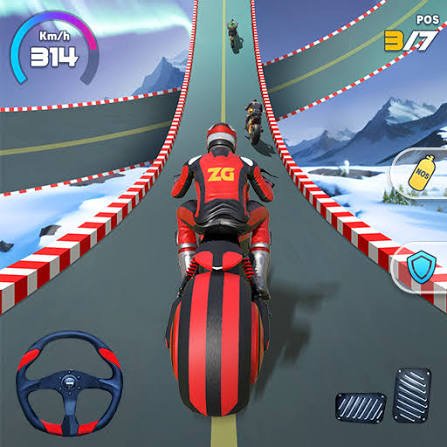


Bike Racer
Bike Racer is a physics-based motorcycle game where you accelerate, brake, balance through jumps, and cross obstacle-filled tracks. Learn each course, control your speed, land safely, collect available rewards, and reach the finish without losing the bike.
Bike Racer
Bike Racer places you on a motorcycle at the beginning of a track filled with hills, ramps, drops, barriers, and uneven ground. Your objective is to reach the finish without losing control of the bike or becoming stuck on a difficult part of the course.
Speed helps on long climbs and wide jumps, but holding the accelerator throughout the whole level rarely produces the best result. A fast approach can send the bike beyond a safe landing area, while braking too early may leave it unable to cross a gap. Strong runs depend on knowing when to build momentum and when to slow down.
Players who enjoy physics-based motorcycle levels can also try Moto X3M, where ramps, hazards, and timed courses require careful bike control.
What Bike Racer Is About
Bike Racer is a browser motorcycle game based on obstacle tracks, balance, speed, and controlled landings.
You guide a rider from the starting point toward a finish line. Each course may include steep slopes, jumps, narrow platforms, rough terrain, or objects that interrupt the safest route.
The main gameplay may involve:
- Accelerating along the track
- Braking before short platforms
- Keeping the motorcycle balanced
- Crossing ramps and gaps
- Landing on both wheels
- Avoiding barriers and track hazards
- Passing checkpoints
- Completing levels
- Beating a target time
- Unlocking later courses or bikes
Several games use the title Bike Racer, so the exact levels and progression system depend on the version available on Gam-core.
Check the instructions and menus inside the game before relying on features from another release with the same name.
How Bike Racer Gameplay Feels
A level often begins with a short, open section where you can test the motorcycle.
The bike may accelerate quickly, but the rider’s balance changes as the ground rises and falls. A small hill can lift the front wheel, while a steep drop can tilt the bike forward before it reaches the next surface.
The main challenge begins when several obstacles appear close together.
You may need enough speed to clear a gap, followed immediately by a controlled landing and a slower turn. Completing the first obstacle is not enough when the motorcycle arrives at the next one in a poor position.
The best runs have a steady rhythm:
- Read the next section.
- Choose a suitable speed.
- Keep the bike level.
- Adjust while airborne when supported.
- Land in the direction of the track.
- Prepare for the next obstacle.
Players looking for road traffic rather than stunt-style courses can play Traffic Rider.
Bike Racer Controls
The exact controls depend on the browser build.
A common keyboard layout may include:
- W or Up Arrow: Accelerate
- S or Down Arrow: Brake or reverse
- A or Left Arrow: Lean or rotate backward
- D or Right Arrow: Lean or rotate forward
- Spacebar: Jump, boost, or another action in supported versions
- R: Restart the level
- Esc: Pause or open the menu
Mobile editions may provide:
- An acceleration button
- A brake button
- Forward and backward balance controls
- Touchscreen restart and pause buttons
Some Bike Racer games are 3D track racers rather than side-view balance games. These may use left and right steering instead of airborne rotation.
Use the control guide shown by the Gam-core edition as the correct layout.
Test the Bike Before Racing Hard
The first safe section of a level can tell you how the motorcycle responds.
Test:
- How quickly it accelerates
- How strongly it brakes
- How easily the front wheel rises
- How much a short balance input changes its angle
- How the suspension reacts after landing
- How quickly the bike reverses
- Whether movement continues after releasing the accelerator
Begin with brief control inputs.
Holding a direction for too long can rotate the bike farther than expected, especially during a jump. Small movements are easier to correct.
Read the Track Ahead
Watching only the ground directly beneath the front wheel leaves very little preparation time.
Look farther along the course for:
- Steep climbs
- Sudden drops
- Ramps
- Narrow platforms
- Gaps
- Moving barriers
- Low ceilings
- Checkpoints
- Finish markers
A long hill may require speed before you reach it. A short landing area may require braking before the ramp.
The correct approach depends on the complete section, not only the obstacle closest to the bike.
Build Momentum Before Hills
Steep hills can stop a motorcycle that approaches too slowly.
Begin accelerating before reaching the bottom so the bike carries useful momentum upward.
While climbing:
- Keep the motorcycle reasonably level
- Avoid unnecessary braking
- Use smooth acceleration
- Watch the top of the hill
- Prepare for what lies beyond the crest
Do not hold full acceleration without checking the other side.
The bike may leave the top as a jump. When the landing area is close, releasing the accelerator near the crest can make the next section easier to control.
Slow Down Before Short Platforms
Not every jump rewards maximum speed.
A short platform may sit between two gaps. Reaching it too quickly can cause the bike to land and immediately travel beyond the far edge.
Before the ramp:
- Check the landing distance.
- Reduce speed when the platform is short.
- Keep the motorcycle aligned.
- Avoid rotating unnecessarily.
- Prepare to brake after landing.
The safest jump is one that places the bike near the useful part of the next surface.
Flying farther is not always progress.
Balance the Bike During Jumps
When the motorcycle leaves the track, its angle can affect the landing.
If the front wheel rises too high, use the forward balance control when supported. If the motorcycle begins pointing downward too sharply, use a small backward adjustment.
Avoid holding either direction throughout the entire jump.
A brief input may be enough to rotate the bike. Continuing can turn a safe landing into a crash.
Watch the shape of the landing surface.
An uphill landing may need the front wheel slightly raised. A downhill landing may require the bike to point lower so both wheels follow the slope.
Land on Both Wheels
A controlled landing allows the motorcycle to continue without losing much speed.
Try to align the bike with the track and bring both wheels close to the surface.
Landing heavily on the front wheel can cause the bike to rotate forward. Landing only on the rear wheel can make it bounce or fall backward.
Before contact:
- Match the bike angle to the ground
- Release unnecessary rotation
- Reduce acceleration when the surface is short
- Look at the obstacle after the landing
- Prepare for suspension movement
Do not make a large correction immediately after touching down. Let the motorcycle settle when it begins bouncing.
Recover From an Uneven Landing
A poor landing does not always end the run.
When the bike touches down at an awkward angle:
- Release the accelerator briefly.
- Check which way it is tipping.
- Make a small opposite balance correction.
- Let both wheels return toward the track.
- Accelerate after control returns.
Pressing every control at once makes the movement harder to understand.
When the bike is trapped or cannot be recovered, restarting from a checkpoint may be faster than continuing to push against the obstacle.
Use Braking as a Control Tool
Braking is not only for stopping at the finish.
It can help you:
- Reduce speed before a small ramp
- Prepare for a steep drop
- Prevent the bike from leaving a platform
- Regain control after landing
- Reverse away from a barrier
- Create a better approach to an obstacle
Some players avoid braking because they believe every level is only about speed.
A brief controlled slowdown can protect much more time than a crash and restart.
Crossing Gaps
A gap normally requires enough speed and a stable approach.
Before attempting it:
- Look at the width
- Check the landing height
- Align the bike
- Build speed gradually
- Avoid turning or rotating on the ramp
- Prepare the landing before reaching the other side
Too little momentum may leave the bike short. Too much speed can send it past the safe area.
Use the first attempt to understand the distance. Make a small speed adjustment on the next run rather than changing everything.
Ramps and Launch Angles
The shape of a ramp affects the bike’s flight.
A steep ramp can lift the front quickly and produce a high jump. A shallow ramp may send the motorcycle farther with less height.
When approaching:
- Keep the bike straight
- Build only the speed the landing requires
- Avoid braking at the final instant unless necessary
- Wait until airborne before making balance corrections
- Watch the landing rather than the height of the jump
The purpose of a ramp is to reach the next section safely. A dramatic flight that ends beyond the track is not a successful attempt.
Handling Rough Terrain
Rocks, bumps, and uneven ground can make the wheels lose contact with the course.
Use controlled acceleration through these areas.
Maximum speed may cause repeated bouncing, making the motorcycle harder to balance. Moving too slowly can leave it stuck between steep bumps.
Try to:
- Keep both wheels close to the surface
- Reduce large balance inputs
- Maintain steady momentum
- Watch the front wheel
- Avoid sudden braking on sharp bumps
- Prepare for small unexpected jumps
A smooth route through rough ground often produces a faster level time than an aggressive approach followed by several recoveries.
Checkpoints and Restarts
Checkpoint systems allow you to continue from a recent section after losing control.
They are useful for learning a difficult obstacle without replaying the entire course.
A restart may still affect:
- Completion time
- Star rating
- Score
- Challenge rewards
- Personal records
Use checkpoints while learning.
After every part of the track becomes familiar, replay the complete level and try to finish without resetting.
If a mistake happens near the beginning of a time-focused run, restarting the whole level may provide a better final result.
Timed Levels
Some Bike Racer versions measure how quickly you reach the finish.
A fast time comes from maintaining momentum without losing control.
To improve:
- Learn the course first
- Reduce unnecessary braking
- Land in the correct direction
- Avoid large jumps when a shorter one is enough
- Use checkpoints only during practice
- Keep the motorcycle stable through rough areas
- Prepare for obstacles before they appear
Do not chase the fastest time during the first attempt.
Completing a clean route gives you a reference. Later runs can remove small delays without becoming reckless.
Collecting Coins and Stars
Supported editions may place coins, stars, fuel, or other rewards around the course.
These items may help unlock:
- New motorcycles
- Additional levels
- Rider outfits
- Colours
- Performance changes
- Cosmetic designs
A reward near the safe route is usually worth collecting.
One placed above a difficult jump or near the track edge may require a separate attempt after you understand the course.
Finishing the level is normally more valuable than collecting one item and losing the run.
Choosing a Bike
Some versions include several motorcycles with different handling.
A bike may vary in:
- Acceleration
- Top speed
- Braking
- Weight
- Balance
- Suspension
- Mid-air response
- Unlock cost
The fastest motorcycle is not always the easiest.
A lighter bike may rotate quickly and require smaller inputs. A heavier vehicle may feel stable but need more momentum on climbs.
Test a newly unlocked bike on an easier track before taking it into a difficult timed level.
Upgrading the Motorcycle
Upgrade systems may improve areas such as:
- Engine power
- Brakes
- Tyre grip
- Suspension
- Stability
- Fuel
- Boost
- Air control
Balanced improvements can be more useful than maximum engine power.
Extra speed makes short platforms and tight landings harder when braking and stability remain weak.
Choose an upgrade that solves a repeated problem. Better acceleration may help with steep hills, while improved braking can support technical tracks with short landing zones.
The exact upgrade system should be confirmed inside the Gam-core version.
Race Modes
A 3D Bike Racer edition may place you against computer-controlled riders rather than using side-view obstacle courses.
In that format, the goal may involve:
- Completing laps
- Passing checkpoints
- Overtaking rivals
- Staying on the track
- Finishing within a time limit
- Using ramps
- Reaching first place
When racing opponents, avoid focusing only on the rider directly ahead.
Watch the track, prepare for corners, and choose passes where enough space remains.
Not every game called Bike Racer includes competitive races, so do not promise these modes unless they appear in the menu.
Overtaking Other Riders
When rival racers are present, pass on open sections rather than forcing the motorcycle into narrow spaces.
Good opportunities may appear:
- On long straights
- After a cleaner corner exit
- When another rider loses speed
- On a wide track section
- After an opponent lands poorly
- Before a clear open route
Avoid attempting a pass immediately before a sharp turn or obstacle.
Completing the first half of an overtake is not useful when the bike enters the next section from a poor angle.
Common Bike Racer Mistakes
The most common mistake is holding the accelerator through the entire level.
Another mistake is ignoring the bike’s angle while airborne.
Players also make balance corrections that are too large. The motorcycle rotates beyond the safe landing position.
Approaching every jump at maximum speed creates further problems, especially when the landing area is short.
Collecting every optional reward during the first run can turn a learning attempt into a series of crashes.
Some players restart without checking what caused the failure.
The final common mistake is assuming a faster bike will correct weak braking or balance habits.
How to Improve at Bike Racer
Begin with control rather than finishing time.
A useful learning order is:
- Test acceleration and braking.
- Learn small balance inputs.
- Complete simple hills.
- Practise controlled jumps.
- Match the bike to landing slopes.
- Cross narrow platforms.
- Learn the full track.
- Collect optional rewards.
- Test another motorcycle.
- Replay for a faster time.
Focus on one repeated mistake during each attempt.
When crashes happen after landing, work on the airborne angle before increasing speed.
Learning From Each Crash
A failed attempt should reveal a specific problem.
You may have:
- Approached too quickly
- Used too little momentum
- Rotated too far
- Landed on one wheel
- Failed to read the next obstacle
- Braked at the wrong time
- Chased an unnecessary collectible
- Entered the ramp at an angle
Choose one correction for the next attempt.
Changing the speed, rotation, and route together makes it difficult to know which change helped.
Browser and Mobile Play
Bike Racer games commonly support desktop browsers and compatible mobile devices.
For smoother play:
- Use an updated browser
- Allow the level to load fully
- Close unnecessary tabs
- Reduce graphics settings when available
- Use fullscreen mode when it improves track visibility
- Avoid resizing the browser during a run
- Test touchscreen controls before a timed level
- Restart after changing performance settings
A stable frame rate helps with balance and landing timing.
Desktop keyboard controls may provide clear movement. Mobile editions usually use visible pedals and balance buttons.
Use the instructions inside the Gam-core version as the correct device guide.
Bike Racer and Real-World Safety
Bike Racer presents jumps, difficult terrain, flips, and high-speed tracks as fictional game mechanics.
These actions should remain inside the game.
Real motorcycle riding requires legal licensing, age-appropriate training, approved protective equipment, road-law compliance, and responsible adult supervision where required.
The World Health Organization road-safety resources explain the real risks connected with speed and unsafe road behaviour.
The FIA road-safety programme also provides information about responsible transport and safer road systems.
Do not copy game jumps, wheelies, flips, racing, or obstacle manoeuvres on public roads or in uncontrolled areas.
What Makes Bike Racer Worth Playing
Bike Racer creates a clear physics challenge from a small number of controls.
The bike feels fast enough to cross steep hills and ramps, but that same speed makes balance important. This gives each obstacle more than one possible approach.
Short levels support quick retries. You can miss a landing, restart, and immediately test a slightly different speed or angle.
The game may feel repetitive for players seeking a story or large open map. Most of the experience centres on reaching the finish and improving the same courses.
That focus is also its strongest quality. Mistakes are easy to recognise, tracks can be learned, and better control produces visible progress.
Players who prefer four-wheeled obstacle courses can try Monster Truck.
Browse the racing games collection for more browser-based vehicle challenges.
Who Will Enjoy Bike Racer?
Bike Racer suits players who enjoy:
- Motorcycle games
- Obstacle tracks
- Physics-based movement
- Ramps and jumps
- Timed levels
- Balance challenges
- Quick restarts
- Unlockable vehicles
- Short browser sessions
Beginners can focus on completing each course without losing control.
More experienced players can reduce completion times, collect difficult rewards, and test motorcycles with different handling.
Players seeking a realistic professional racing simulation should check which modes the Gam-core edition includes.
Those who enjoy direct track challenges are more likely to appreciate its simple controls and changing terrain.
Play Bike Racer Free Online
Play Bike Racer free online on Gam-core.com and guide a motorcycle through hills, ramps, gaps, rough surfaces, narrow platforms, and timed track challenges.
Build enough momentum for steep climbs, reduce speed before short landing areas, and make small balance corrections while the motorcycle is airborne. Reaching the finish quickly matters, but a controlled landing is what keeps the run alive long enough to get there.




Reviews
There are no reviews yet.