
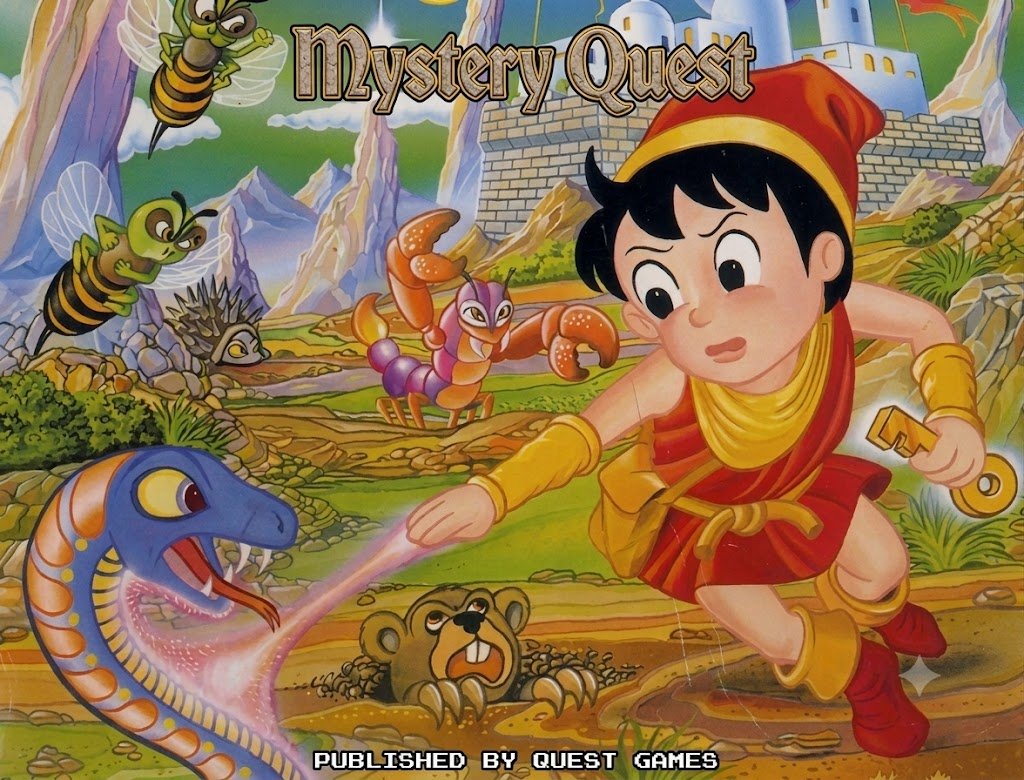


Mystery Quest
Mystery Quest is a classic side-scrolling fantasy platform game where apprentice wizard Hao travels above and below ground in search of four magical talismans. Jump across hazards, fire magic at enemies and hidden blocks, collect keys and special equipment, and solve the confusing routes inside four Mystery Castles.
Mystery Quest Classic Fantasy Platform Adventure
Mystery Quest is a side-scrolling fantasy platform game where players guide a young apprentice named Hao through outdoor routes, underground passages, and four maze-like castles. His goal is to recover four magical talismans and prove that he is ready to become a powerful wizard.
The game mixes traditional jumping and projectile-based action with exploration. Progress often requires more than reaching the right side of the screen. Hao must enter doors, find keys, uncover hidden passages, break special blocks, collect magic upgrades, and remember routes through complicated castle interiors.
What Is Mystery Quest?
Mystery Quest is a single-player platform game developed by Carry Lab. It first appeared in Japan in 1987 as Hao-kun no Fushigi na Tabi, published through Square’s Disk Original Group for the Family Computer Disk System. Taxan later released the localized NES version in North America in April 1989. (Wikipedia)
The game follows Hao, an apprentice challenged by the Great Wizard to travel through four Mystery Castles. Each castle contains a magical talisman representing an important gift, including money, knowledge, family, and peace.
Reaching those talismans requires Hao to cross a connected world, enter confusing castles, find hidden equipment, and overcome enemies protecting important keys.
Players who enjoy classic side-scrolling movement may also like Super Nob Run Adventure Jungle. Mystery Quest places greater emphasis on castle mazes, hidden blocks, keys, and exploration.
The Story of Hao’s Journey
Hao has spent a long time studying magic under the Great Wizard.
Before his training can be considered complete, the wizard gives him one final challenge. Hao must visit four Mystery Castles and recover the magical objects hidden inside them.
The journey is dangerous because the castles contain underground passages, confusing doors, concealed rooms, water hazards, and unusual creatures. Helpful powers are hidden throughout the world, but many require careful searching or upgraded abilities to reach.
The four talismans represent the rewards Hao hopes to understand through his journey:
- Wealth
- Wisdom
- Happiness or family
- Peace
The original instruction manual describes the quest as Hao’s chance to prove that he can become as accomplished a wizard as his teacher.
How Mystery Quest Gameplay Works
Mystery Quest alternates between outdoor platforming and indoor castle exploration.
Outdoor areas usually encourage forward movement. Hao jumps over hazards, fires magic at enemies, searches blocks for useful items, and looks for entrances leading underground or into a castle.
Castles are more complicated. They contain connected rooms, locked doors, misleading passages, breakable blocks, spring platforms, hidden items, and enemies that provide keys.
A typical gameplay cycle follows this pattern:
- Move through an outdoor area.
- Avoid or defeat roaming enemies.
- Search suspicious blocks and scenery.
- Use platforms and springs to reach higher paths.
- Enter a Mystery Castle.
- Study its connected rooms and doors.
- Defeat the monster carrying a key.
- Unlock the correct door.
- Find a magical upgrade or talisman.
- Leave the castle and continue across the world.
The official manual explains that Hao travels both above and below ground. It also warns that finding the hidden items becomes increasingly difficult in later castles.
Mystery Quest Controls
The original NES game uses a simple control scheme.
| Action | Original NES Control |
|---|---|
| Move left or right | Control Pad left or right |
| Enter a door | Control Pad up |
| Duck or climb down | Control Pad down |
| Jump | A button |
| Fire magic | B button |
| Pause or continue | Start button |
The Select button does not perform an important normal gameplay action.
Browser emulators may map these controls to keyboard keys. Common layouts use arrow keys for movement and letter keys for the NES A and B buttons, but the exact mapping depends on the version running on the website.
Check the control panel displayed around the game before starting.
The original manual confirms that A controls jumping, B fires Hao’s magic, Up enters doors, Down ducks or climbs, and Start pauses the game.
Moving Through the World
Movement initially appears simple, but Mystery Quest gives jumping more depth than many early platform games.
Hao can walk across normal ground, climb through certain passages, enter doors, bounce from spring blocks, and use enemies or moving objects to reach higher areas.
Outdoor routes include:
- Hills
- Trees and stumps
- Water
- Bridges
- Walls
- Clouds
- Underground openings
- Spring platforms
- Hidden blocks
- Castle entrances
Not every piece of scenery is decorative. Jumping on a stump, mountain, chimney, or another unusual surface may reveal a vitality item.
Players should test safe-looking objects instead of rushing past every background detail.
Understanding Hao’s Jump
A quick press creates a normal jump.
Repeated or carefully timed jumping can help Hao reach greater heights. Certain walls contain spring blocks that throw him upward, while some enemies can also be used as temporary platforms.
The game sometimes expects players to combine horizontal movement with several consecutive bounces.
When a high ledge seems unreachable:
- Look for a spring block
- Check the side of nearby walls
- Try jumping repeatedly
- Search for a moving enemy
- Fire at nearby blocks
- Look for another route through a door
Platforming becomes more demanding later in the journey, especially near water and inside narrow castle rooms.
Spring Blocks
Spring blocks launch Hao higher than a normal jump.
Some are positioned on the floor, while others appear along vertical walls. Floor springs are easy to understand, but wall springs require careful direction changes.
A useful wall-spring approach is:
- Jump toward the spring.
- Let it launch Hao away from the wall.
- Turn toward the opposite surface.
- Press jump again at the correct moment.
- Continue until Hao reaches the upper platform.
Do not hold one direction continuously without watching Hao’s position. He may bounce past the intended ledge or fall into a hazard.
Firing Magic
Hao can fire a magical projectile in the direction he is facing.
Magic is used to:
- Defeat enemies
- Reveal hidden items
- Break certain blocks
- Open concealed routes
- Remove obstacles
- Reach objects inside walls
- Gain points from some scenery
Players should fire at suspicious walls, stair blocks, ceilings, and isolated objects.
A section that appears to be a dead end may contain a block that disappears after being struck. Some valuable upgrades are hidden inside ordinary-looking castle walls.
Shooting While Moving
Hao can fire while walking and jumping.
Shooting frequently helps clear enemies before they move too close. It can also reveal breakable blocks while Hao continues across the stage.
However, concentrating only on firing can lead to missed jumps.
Use short bursts near:
- Water
- Narrow platforms
- Wall springs
- Floor hazards
- Hidden passages
- Enemies approaching from different heights
Learning to coordinate movement and magic is one of the game’s main challenges.
Above-Ground and Underground Routes
The world contains connected upper and lower paths.
Hao may fall or climb through openings that lead to underground sections. These lower routes can contain recovery items, alternative paths, castle entrances, and connections back to the surface.
The world is not a collection of completely separate stages. It behaves more like one extended journey with castles placed at important points.
This design can make navigation confusing because an opening may move Hao into a different part of the map rather than a small bonus room.
Pay attention to:
- Direction signs
- Castle locations
- Openings in the ground
- Where Hao returns to the surface
- Whether the journey is currently moving left or right
The Four Mystery Castles
The four castles form the main progression objectives.
Each castle is a maze built from rooms connected by doors. Entering a door can place Hao on another side of a wall or in a distant part of the structure.
Inside the castles, players must:
- Find the correct route
- Search breakable walls
- Defeat key-carrying monsters
- Open locked doors
- Collect equipment
- Avoid hazardous floors
- Use spring blocks
- Locate the castle’s talisman
- Find the correct exit
The first castle introduces the maze system. Later castles use more concealed passages and less obvious item locations.
The official manual states that hidden objects are relatively easy to find in the first castle but much harder to locate in the fourth.
Castle Doors
Doors connect different parts of a castle.
Press Up while standing in front of an accessible door to enter it.
Some doors are open immediately. Others display a key symbol and cannot be entered until Hao finds a key.
Because many rooms look similar, it is easy to return through the wrong door. Try to remember:
- The number or symbol near the entrance
- Whether the route moved upward or downward
- Which doors remain locked
- Where a key-carrying monster appeared
- Where a valuable item was visible but unreachable
Players who enjoy learning connected rooms and solving route problems may also like Escape Game Basic.
Keys and Locked Doors
Hao can carry a key used to open a door marked with the key symbol.
Keys are commonly obtained after defeating special monsters inside the castles. A key should not be used automatically on the first locked door encountered because another route may lead to a more important objective.
Before opening a door:
- Check nearby unlocked paths.
- Remember where other locked doors appeared.
- Look for an arrow or numbered marker.
- Consider whether the door appears connected to the talisman route.
- Search the room for another hidden key.
The instruction manual confirms that marked doors require keys and that castle monsters leave keys after being defeated.
Breakable Castle Blocks
Castle walls contain several kinds of interactive blocks.
Some disappear when shot. Others can be broken by jumping on them or hitting them from below after collecting the correct upgrade.
Possible block interactions include:
| Block Interaction | Result |
|---|---|
| Fire magic at the block | Some walls disappear |
| Jump onto a special block | It may break |
| Hit a block from underneath | It may disappear |
| Jump onto a spring block | Hao is launched upward |
| Search behind broken walls | Items or passages may appear |
Do not assume two similar-looking walls behave the same way.
When one attack method does not work, return after collecting Power Boots, a Power Helmet, or an improved magic shot.
Magic Items
Hao can collect several permanent or temporary abilities.
| Item | Main Effect |
|---|---|
| Power Boots | Allow Hao to break certain blocks by landing on them |
| Power Helmet | Allows certain blocks to be broken from below |
| Super Cape | Provides additional protection |
| Scroll | Doubles the power of Hao’s magic shot |
| Magic Lamp | Gives temporary protection |
| SOS Raft | Saves Hao from one fall into dangerous water |
| Key | Opens one marked castle door |
| Emerald Stone | Doubles the score |
| Direction Arrow | Shows the intended route |
These items support both survival and exploration.
Power Boots and the Power Helmet are especially useful because they allow Hao to reach areas that initially appear closed. The Scroll improves his projectile and helps break stronger blocks.
The official manual documents these magic items and explains their main effects.
Power Boots
Power Boots allow Hao to break selected blocks by jumping onto them.
After collecting the boots, revisit floors that looked unusual or blocked a lower route.
To use them:
- Stand above the suspected block.
- Jump and land directly on it.
- Repeat when the block requires more than one impact.
- Drop carefully after it breaks.
- Check the lower area before falling.
Do not break every floor immediately. Some blocks may be protecting Hao from water, spikes, or a difficult return route.
Power Helmet
The Power Helmet lets Hao break certain blocks by jumping into them from below.
It is useful for:
- Opening ceiling paths
- Revealing hidden items
- Reaching upper rooms
- Removing blocks above spring platforms
- Entering concealed passages
Position Hao directly beneath the block before jumping.
If the block does not react, it may require magic, the boots, or a stronger projectile instead.
Magic Scroll
The Scroll doubles Hao’s shooting power.
Stronger magic can remove blocks that resist the normal projectile and makes some enemy encounters easier.
This upgrade is important because Mystery Quest often hides progress behind walls that initially appear permanent.
After obtaining the Scroll, fire at:
- Suspicious castle walls
- Groups of identical blocks
- Ceilings above doors
- Blocks beside visible items
- Dead ends
SOS Raft
The SOS Raft protects Hao from one fall into dangerous water.
Without it, deep water can immediately end the attempt. The raft is consumed after saving him once.
Treat it as emergency protection rather than a normal transportation tool.
Keep it for:
- Long jumps over water
- Difficult wall-spring sections
- Narrow platforms
- Areas where enemies can knock Hao into a pool
- A route that intentionally requires entering water
The manual confirms that the SOS Raft works only once.
Vitality Items
Hao’s vitality represents his remaining health.
Several collectible items can restore or increase it.
| Vitality Item | Effect |
|---|---|
| Star | Restores a small amount of vitality |
| Moon | Restores all vitality |
| Hao doll | Increases the available vitality supply |
Stars may appear after jumping on environmental objects or defeating enemies. Moons can be hidden inside walls, making exploration valuable even when Hao is not close to losing.
The original manual lists Stars, Moons, and Hao dolls as the main vitality items.
Water and Floor Hazards
Water is one of the most serious dangers.
Shallow water drains vitality, while deep water can immediately defeat Hao unless he is carrying an SOS Raft.
Castles also include damaging floor sections such as nail floors and skull-covered areas.
Useful habits include:
- Jump before reaching the edge
- Avoid landing directly beside an enemy
- Keep an SOS Raft for difficult water sections
- Search for moving clouds or blocks that provide a safer route
- Do not stand on damaging floors
- Restore vitality before entering a castle
The manual explains that shallow water drains vitality, deep water causes immediate defeat, and nail floors should be jumped over.
Enemies
Outdoor areas contain several small creatures with different movement patterns.
Known enemy types include:
- Dragonflies
- Scorpions
- Wasps
- Snakes
- Porcupines
- Bats
- Gophers
Some move along the ground, while others fly toward Hao or approach in curved patterns.
The best response depends on the enemy:
| Enemy Behavior | Helpful Response |
|---|---|
| Slow ground movement | Fire before it gets close |
| Fast rushing movement | Jump to another lane or platform |
| Flying approach | Fire while adjusting jump height |
| Enemy appearing from the ground | Keep moving and watch the floor |
| Enemy near water | Avoid jumping without checking the landing |
| Enemy below a high ledge | Consider using it as a temporary platform |
Hao can jump on some enemies to defeat them or use them to gain extra height.
Castle Monsters
Each castle contains a stronger monster connected with key progression.
The manual names several castle monsters, including:
- Kiri Kiri
- Mel
- Dragon
- Birdman
Defeating one causes a key to appear.
These encounters are more demanding than normal outdoor enemies because they may fire projectiles, remain in difficult positions, or control narrow parts of a room.
Keep enough distance to observe the movement pattern before firing continuously.
Hidden Items and Secret Walls
Mystery Quest rewards experimentation.
Items can be hidden inside:
- Trees
- Walls
- Ceilings
- Stairs
- Floor blocks
- Decorative objects
- Stumps
- Mountains
- Chimneys
- Candles
Fire at isolated objects and jump on raised scenery.
A room containing nothing obvious may still hide a Moon, raft, score item, or route behind an ordinary wall.
However, searching every single tile can slow the game considerably. Focus first on unusual block arrangements and locations near visible but unreachable items.
Signs and Arrows
Direction signs help Hao understand where to travel.
Arrows appear in outdoor and castle areas, although they do not always reveal every secret. A sign may point toward the main route while an optional item remains hidden in another direction.
Use arrows as guidance, not as a complete solution.
When lost inside a castle:
- Return to the last familiar door.
- Follow numbered or directional markers.
- Search for a monster carrying a key.
- Check walls near inaccessible areas.
- Avoid entering the same door repeatedly without noting the result.
Score Items
Several collectibles are primarily connected with score.
These may include wizard hats, brooms, flowers, Emerald Stones, and other hidden bonuses.
Score does not replace the need to collect the talismans, but it gives experienced players another reason to investigate each area.
A high-scoring run involves:
- Finding hidden bonus items
- Defeating enemies
- Collecting the score multiplier
- Preserving vitality
- Reaching secret sections
- Completing more than one quest cycle
Beginners should focus on survival and navigation before attempting to find every score item.
Game Over Conditions
The attempt ends when Hao loses all vitality or enters deep water without an SOS Raft.
Vitality can be reduced by:
- Contact with enemies
- Standing on harmful terrain
- Shallow water
- Castle hazards
- Mistimed jumps
- Enemy projectiles
The game requires patience because losing late in a castle may mean replaying a considerable section.
Collect Stars and Moons when available instead of saving every recovery opportunity for later.
Difficulty
Mystery Quest can feel difficult for several reasons:
- Jump timing is unusual
- Castles contain maze-like layouts
- Hidden passages are not clearly marked
- Some jumps require spring techniques
- Water can immediately end an attempt
- Keys can be used on different doors
- Later talismans are carefully concealed
- The game provides limited direction
- Older platform controls feel less forgiving than modern games
The difficulty is not based only on fast reactions. Observation and memory are equally important.
A player may know how to defeat every enemy but still become stuck because one wall has not been tested.
Learning the Castle Layouts
Drawing a small route map can help with the more confusing castles.
Record:
- Door numbers
- Locked doors
- Monster rooms
- Spring locations
- Visible upgrades
- Breakable walls
- Talisman rooms
- Exits
A simple note such as “Door 2 leads to the room with the helmet” can save several minutes.
Players who do not want to write anything can create a mental rule, such as checking every lower door before moving to upper rooms.
Is Mystery Quest a Puzzle Game?
Mystery Quest is primarily a platform action game, but it contains puzzle-like exploration.
Its puzzles involve:
- Identifying breakable walls
- Choosing the correct door
- Finding keys
- Reaching high platforms
- Understanding spring movement
- Searching for hidden items
- Learning the castle route
There are no dialogue riddles or traditional inventory-combination puzzles.
The challenge comes from understanding the environment while controlling Hao through hazards.
Is Mystery Quest Multiplayer?
No. Mystery Quest is a single-player game.
Only one person controls Hao, and there is no cooperative or competitive mode in the original NES release.
Players wanting direct multiplayer action can browse the Gam-core games collection for additional browser and online titles.
Can Mystery Quest Be Played in a Browser?
The original game was made for the Family Computer Disk System and Nintendo Entertainment System.
A browser version normally uses retro-game emulation. The site may provide virtual NES controls through keyboard keys, a connected controller, or touchscreen buttons.
Browser features may include:
- Keyboard remapping
- Full-screen mode
- Save states
- Controller support
- Sound adjustment
- Reset controls
These are emulator features rather than systems included in the original cartridge.
Use only the controls and options provided by the current game page.
Browser Controls
A common browser configuration may look like this:
| NES Input | Possible Browser Input |
|---|---|
| D-pad | Arrow keys |
| A button | X, Z, or another assigned key |
| B button | Z, X, or another assigned key |
| Start | Enter |
| Select | Shift |
| Pause emulator | Escape or menu button |
These keys are not universal.
Check the instructions beside the play area before beginning. When Hao moves but cannot jump or fire, the A and B keys may be assigned in the opposite order.
Playing With a Controller
A modern USB or Bluetooth controller may work when the browser emulator supports gamepads.
Map the buttons so that:
- The directional pad controls movement
- One face button jumps
- Another face button fires
- Start pauses
- Up can be pressed reliably at doors
A directional pad may feel more accurate than an analog stick during narrow spring and water sections.
Is Mystery Quest the Same as the 2022 PC Game?
No.
Another game titled Mystery Quest was released for PC in 2022 and uses a match-three format. It is unrelated to the Carry Lab NES platform game.
The classic version described here can be identified by:
- Hao as the hero
- Four magical talismans
- Four Mystery Castles
- Side-scrolling platform movement
- NES-style graphics
- Jumping and magic shots
- Castle keys and breakable blocks
- Carry Lab as the developer
Graphics and Presentation
Mystery Quest uses colorful 8-bit graphics.
Outdoor areas include bright skies, hills, trees, water, buildings, and small animated enemies. Castles use repeating brick patterns, narrow platforms, doors, springs, and concealed rooms.
The repeated blocks support the maze design but can also make rooms look similar.
Important objects remain visually recognizable:
- Keys
- Doors
- Arrows
- Talismans
- Moons
- Stars
- Spring blocks
- Water
- Enemy projectiles
The graphics are simple, but careful visual attention remains important.
Who Should Play Mystery Quest?
Mystery Quest suits players who enjoy:
- Classic NES games
- Side-scrolling platformers
- Fantasy adventures
- Hidden passages
- Maze-like castles
- Retro difficulty
- Collectible upgrades
- Single-player challenges
- Exploration mixed with action
- Learning through repeated attempts
Players who want faster hero-based action may enjoy Ultimate Heroes.
Mystery Quest may be less suitable for players looking for:
- Modern checkpoints
- Online multiplayer
- A large story with dialogue
- Simple linear stages
- Automatic guidance
- Detailed tutorials
- Frequent save points
Honest Strengths and Limitations
| Strengths | Possible Limitations |
|---|---|
| Combines platforming with exploration | Castle layouts can become confusing |
| Four talismans provide a clear objective | Hidden routes receive little explanation |
| Magic can reveal secret paths | Players may need to fire at many walls |
| Equipment changes how blocks are broken | Important upgrades can be missed |
| Outdoor and castle areas feel different | Repeated castle graphics can look similar |
| Springs add unusual movement challenges | Wall jumping takes practice |
| Keys create route decisions | A key may be used on an unhelpful door |
| Vitality items reward exploration | Recovery is not always available |
| Retro graphics remain easy to recognize | Controls may feel stiff to modern players |
| Suitable for short browser sessions | Losing late in a section can be frustrating |
| Single-player play needs no account | No multiplayer mode is included |
| Browser emulation can add save options | Emulator controls vary by website |
Tips for Playing Mystery Quest Better
Test the Controls First
Confirm which key jumps and which key fires before reaching the first hazard.
Fire at Suspicious Blocks
Walls near visible items often contain secret openings.
Jump on Scenery
Stumps, mountains, chimneys, and other objects may reveal vitality items.
Save the SOS Raft
Keep it for a difficult water crossing rather than using it carelessly.
Search Before Opening a Locked Door
Another route may provide a better use for the current key.
Remember Door Numbers
Castle markers make it easier to understand where each entrance leads.
Collect Recovery Items
Do not enter a dangerous castle with very low vitality.
Practise Spring Jumps
Later sections expect players to control repeated bounces between walls.
Use Enemies Carefully
Some can be jumped on or used to reach higher areas.
Return After Finding Upgrades
Power Boots, the Power Helmet, and stronger magic can open previously inaccessible paths.
Avoid Rushing Near Water
Check the landing area before making a long jump.
Search the Talisman Room Thoroughly
The final object may be concealed behind blocks rather than placed in the open.
Mystery Quest Game Information
| Detail | Information |
|---|---|
| Game title | Mystery Quest |
| Japanese title | Hao-kun no Fushigi na Tabi |
| Developer | Carry Lab |
| Japanese publisher | Square Disk Original Group |
| North American publisher | Taxan |
| Original Japanese release | 1987 |
| North American release | April 1989 |
| Original platforms | Family Computer Disk System and NES |
| Genre | Side-scrolling platform action |
| Main character | Hao |
| Main objective | Recover four magical talismans |
| Main locations | Outdoor routes, underground areas, and four castles |
| Main actions | Move, jump, fire magic, enter doors, and search blocks |
| Castle structure | Maze-like connected rooms |
| Main upgrades | Power Boots, Power Helmet, Scroll, Cape, Lamp, and Raft |
| Vitality items | Stars, Moons, and Hao dolls |
| Multiplayer | No |
| Main mode | Single-player |
| Browser play | Available through supported retro emulation |
| Original controller | NES controller |
The developer, release history, platform, genre, story, controls, items, enemies, and castle systems are documented by historical game records and the original North American instruction manual. (Wikipedia)
Frequently Asked Questions
What Type of Game Is Mystery Quest?
Mystery Quest is a single-player side-scrolling platform game with fantasy action, hidden items, breakable blocks, and maze-like castles.
Who Is the Main Character?
The main character is Hao, a young apprentice trying to prove himself to the Great Wizard.
Who Developed Mystery Quest?
Mystery Quest was developed by Carry Lab. (MobyGames)
When Was Mystery Quest Released?
The original Japanese version was released in 1987. The North American NES version followed in April 1989. (Wikipedia)
What Was Mystery Quest Called in Japan?
It was released as Hao-kun no Fushigi na Tabi.
What Is the Main Objective?
Hao must travel through four Mystery Castles and recover four magical talismans.
What Do the Four Talismans Represent?
They represent money or wealth, knowledge or wisdom, family or happiness, and peace.
How Do You Jump?
Press the NES A button or the browser key mapped to A.
How Do You Fire Magic?
Press the NES B button or the browser key assigned to B.
How Do You Enter Doors?
Stand in front of a door and press Up.
Why Will a Door Not Open?
A door displaying a key symbol requires Hao to carry a key.
How Do You Find Keys?
Defeat the special monsters found inside the castles. They leave keys after being defeated.
What Do Power Boots Do?
Power Boots allow Hao to break certain blocks by jumping onto them.
What Does the Power Helmet Do?
The Power Helmet allows Hao to break selected blocks by striking them from below.
What Does the Scroll Do?
The Scroll doubles Hao’s shooting power and helps break stronger blocks.
What Does the SOS Raft Do?
The SOS Raft saves Hao from one fall into dangerous water before disappearing.
What Happens in Deep Water?
Hao is defeated unless he has an unused SOS Raft.
How Do You Restore Vitality?
Collect Stars for partial recovery and Moons for full recovery.
Why Am I Stuck in a Castle?
Search walls and floors, defeat the monster carrying a key, check numbered doors, and test blocks with Hao’s current upgrades.
Can Some Walls Be Broken?
Yes. Some disappear when shot, jumped on, or struck from below with the proper equipment.
Is Mystery Quest Multiplayer?
No. The original game is single-player only.
Is Mystery Quest an NES Game?
Yes. The North American version was released for the Nintendo Entertainment System.
Can Mystery Quest Be Played Online?
Browser versions may run through a supported NES emulator. Keyboard mappings depend on the website.
Does Mystery Quest Have Save Points?
The original cartridge was designed around continuous play rather than modern automatic checkpoints. A browser emulator may provide optional save states.
Is Mystery Quest a Hidden-Object Game?
No. It is a platform action game, although it does contain many hidden upgrades, blocks, and passages.
Is Mystery Quest the Same as the 2022 Steam Game?
No. The 2022 title is a separate match-three game. The classic Mystery Quest follows Hao through four castles.
What Is the Best Beginner Strategy?
Move carefully, fire at suspicious blocks, collect recovery items, practise spring jumps, and remember where locked doors appear.





Reviews
There are no reviews yet.