
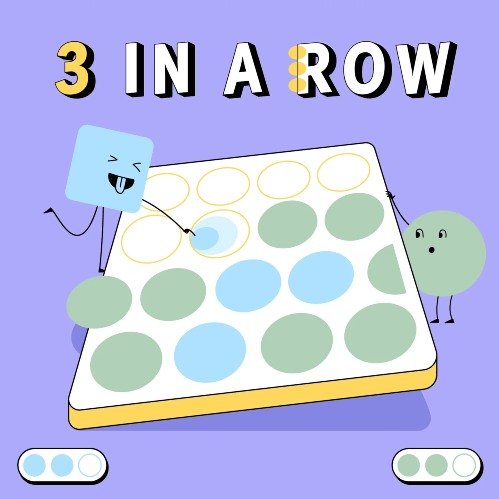


Three In A Row
Three In A Row is a colorful match-three puzzle where you swap adjacent items to create groups of three or more. Plan around limited moves, build useful power-ups, clear difficult corners, and use cascades to improve your score.
Three In A Row Match 3 Puzzle Game
Three In A Row is a colorful match-three puzzle where every swap can change the shape of the board. You move adjacent items to create groups of three or more matching pieces, clear space, and build a higher score. The controls are simple, but later levels ask you to think carefully about limited moves, difficult board areas, and possible combinations.
The browser version of Three In A Row was developed by 3d Alexx. It supports PC, Android, and iOS browsers, so players can use a mouse or touchscreen without installing a traditional game package.
What Is Three In A Row?
Three In A Row is a single-player matching puzzle built around finding and creating groups of identical items. The board contains colorful pieces arranged in a grid, and your task is to swap nearby items until at least three matching pieces form a line.
Successful matches disappear from the board and increase your score. New pieces then enter the empty spaces, creating a different layout for your next move.
The game was released in November 2024 and uses the Unity engine. Its listed categories include puzzle, match three, matching, brain, and logic games.
Players who enjoy matching colorful objects may also like the fruit-matching bubble puzzle, which replaces tile swapping with aiming and shooting.
How Three In A Row Gameplay Works
A level begins with a grid filled with several types of colorful objects. You select one item and exchange its position with an adjacent piece.
The move should create a line containing at least three identical items. When the match is accepted, those pieces disappear and the spaces are filled by objects moving down the board.
A normal turn follows a clear pattern:
- Inspect the full grid.
- Find two adjacent pieces that can create a match.
- Swap their positions.
- Clear the matching line.
- Study the changed board before moving again.
Random swaps may work during an easy opening level, but they become less useful when the number of available moves is limited.
Creating Basic Matches
The smallest valid group contains three identical objects. These pieces usually need to form a straight horizontal or vertical line.
A basic match is useful for opening the board, earning points, or moving important pieces toward a better position. However, the first visible group may not be the strongest move available.
Before creating a group of three, check whether the same pieces could be arranged into a longer line. Matching more than three items can create a power-up or a stronger clearing effect.
Matching More Than Three Items
Larger matches are valuable because they can create special pieces. These power-ups help remove more items than an ordinary three-piece group.
The exact effect depends on the match and the current version of the game. A special piece may clear a wider section, remove several similar objects, or help open a difficult part of the board.
Do not activate every power-up immediately. Its position can matter as much as its clearing strength.
A power-up placed near the center may affect several useful areas. The same piece used in an empty corner may provide only a small benefit.
Planning Around Limited Moves
Many levels provide a fixed number of moves. This means every swap should contribute to the score, objective, or next useful combination.
Watch the remaining-move counter throughout the level. Do not wait until the final two moves before checking whether you are close to the goal.
When moves are limited, prioritize:
- Matches connected to the level target
- Groups of more than three items
- Power-up creation
- Difficult corners and narrow sections
- Moves that can produce automatic combinations
A simple match may be legal without being helpful. Compare several possible swaps before choosing one.
Cascades and Automatic Matches
A cascade occurs when pieces falling into cleared spaces form another match automatically.
For example, clearing a group near the bottom causes many pieces above it to move. Those falling objects may create another line without using an additional move.
Cascades are useful because they can add points and clear space for free. They can also activate special pieces or create new power-ups.
Matching near the lower part of the board often produces more movement than matching near the top. This can improve the chance of a cascade, although the incoming pieces are not fully predictable.
Players who prefer building chains with numbers can try the 3D number-merging puzzle, where equal cubes combine into higher values.
Reading the Full Board
New players often focus on one small section of the grid. This can cause them to miss stronger combinations elsewhere.
Before moving, scan the board from top to bottom. Look for ready-made pairs, groups that need one extra piece, and spaces where a larger match could be prepared.
It helps to identify at least two possible moves. You can then compare which one:
- Clears more items
- Creates a power-up
- Opens a restricted area
- Supports another match
- Uses fewer valuable moves
The strongest choice is not always the one that gives the largest immediate score. A smaller match can set up a much better second move.
Difficult Corners and Edge Spaces
Corners are harder to clear because pieces can approach them from fewer directions. Edge spaces also offer fewer matching patterns than the center.
When a level places important objects or blocked spaces near a corner, deal with them early. Waiting until the last few moves may leave no useful matching pieces nearby.
The center is generally more flexible because it connects with several rows and columns. Keeping this area active can make it easier to build longer combinations.
Do not focus only on the center, though. A board can look open while important edge areas remain untouched.
Main Three In A Row Features
- Classic match-three structure: Swap adjacent items to create groups containing three or more matching pieces.
- Level-based progression: Complete changing boards and increasingly difficult matching challenges.
- Limited-move puzzles: Plan swaps carefully when a level restricts how many moves can be made.
- Power-up creation: Larger matches can produce special pieces with stronger clearing effects.
- High-score play: Efficient matches, cascades, and combinations help increase the current score.
- Simple controls: Use a mouse on a computer or a finger on a touchscreen.
- Cross-device browser support: The game is listed for PC, Android, and iOS devices.
- Portrait presentation: The vertical layout fits naturally on mobile screens.
- Single-player format: Progress through the puzzles without live multiplayer competition.
- No required installation: The browser edition can be started without downloading a large game file.
Three In A Row Controls
Three In A Row uses simple pointer and touchscreen controls.
| Action | Computer | Mobile Device |
|---|---|---|
| Select an item | Click it | Tap it |
| Swap adjacent items | Click and drag | Swipe |
| Choose another item | Click a nearby piece | Tap a nearby piece |
| Activate a power-up | Click it or include it in a match | Tap it or include it in a match |
| Open the menu | Click the menu button | Tap the menu button |
| Restart a level | Select restart | Tap restart |
| Enter fullscreen | Select fullscreen | Use the available screen option |
The official instructions state that players can use a mouse or finger to swap adjacent items.
How the Difficulty Changes
The opening levels give players enough space to understand matching and movement. Several possible groups may be visible at the same time.
Later boards become harder through stricter move limits, unusual layouts, difficult matching positions, or higher score targets.
The challenge comes from finding efficient swaps rather than using fast reactions. You can usually inspect the board before deciding what to move.
More experienced players begin to notice patterns such as:
- Two matching objects waiting for a third
- A possible four-piece line
- A move that creates two groups
- A lower match that can begin a cascade
- A power-up that can reach several targets
Common Three In A Row Mistakes
Taking the First Available Match
A visible match is not automatically the best option. Scan the rest of the grid before committing to it.
Ignoring the Remaining Moves
Making several low-value matches can leave too few moves to complete the level.
Using Power-Ups in Weak Positions
A power-up should affect an important or crowded part of the board. Activating it in an empty area may waste its effect.
Matching Only Near the Top
Top-board matches move fewer pieces. Lower matches can change more of the grid and may create cascades.
Leaving Corners Until the End
Important corner spaces can become difficult to reach. Clear them while several matching options remain.
Focusing Only on Points
A high score may not complete a level when another objective is still unfinished.
Repeating the Same Failed Moves
When replaying a level, try a different opening. Repeating the same swaps often produces the same weak board.
Useful Tips for Better Matches
Inspect Every Offered Move
Take a few seconds to study the full board. There is normally no advantage in rushing an obvious match.
Begin With Difficult Areas
Clear corners, edges, and narrow spaces before they become isolated.
Look for Groups of Four
A larger match may create a useful power-up and provide more value than a standard group of three.
Work Near the Bottom
Lower matches move a larger number of pieces and increase the possibility of automatic combinations.
Build Around Existing Pairs
Two matching pieces placed close together may need only one carefully positioned item to form a group.
Save Strong Power-Ups
Keep special pieces until their effects can reach a useful section of the board.
Watch What Will Fall
Check the objects above your planned match. Their movement may create another group or damage a setup you wanted to keep.
Check the Goal Frequently
Do not spend moves clearing items that have no connection to the current challenge.
Pause Before the Final Move
When only one move remains, inspect every possible swap. A hidden cascade or larger group may be available.
Graphics and Sound
Three In A Row uses bright colors and clearly shaped puzzle objects. The portrait grid keeps the pieces, score, and move information visible on mobile screens.
Short animations show matching objects disappearing and new items falling into place. These effects make it easier to understand how one move changes the board.
The visual style is simple enough to keep attention on the matching patterns. Players can quickly separate different object types without studying a complicated interface.
Sound effects support matches, cascades, power-up activation, and successful level completion. Audio is not required for understanding the game.
Players who prefer careful visual observation can try the hidden differences picture game, which asks players to compare two similar images and locate small changes.
Progress Saving and Browser Play
Three In A Row can be played through a supported browser without a normal installation. The hosting page states that registration is not required to begin playing.
Players can sign in to the hosting platform when they want to keep progress available across supported devices. Without an account, saved progress may depend on browser data and local storage.
The game is listed for computers, Android devices, and iOS devices. Its portrait orientation is particularly suitable for phones, although it can also be played on a desktop screen.
Who Should Play Three In A Row?
Three In A Row is suitable for players who enjoy casual matching puzzles, colorful boards, high scores, and short levels.
The basic swap controls make it approachable for beginners. More experienced puzzle players can focus on larger combinations, cascades, power-up placement, and efficient use of limited moves.
It may also suit players who want a browser game that can be opened without a long tutorial or large download.
People looking for live multiplayer, action combat, a detailed story, or character progression may find the format too simple.
Players who want a different type of logic challenge can try a browser escape puzzle based on finding clues and solving room-based problems.
Honest Strengths and Limitations
| Strengths | Possible Limitations |
|---|---|
| Matching rules are easy to understand | The main gameplay loop may feel familiar |
| Mouse and touchscreen controls are supported | New pieces can change a planned setup |
| Larger groups create useful power-ups | Later levels may require repeated attempts |
| Limited moves encourage careful planning | No live multiplayer mode |
| Cascades can create satisfying chain reactions | High scores depend partly on the changing board |
| Runs directly through a browser | Progress saving may require an account |
| Works across computers and mobile devices | Portrait presentation may feel narrow on desktop |
| Suitable for short puzzle sessions | Players seeking action may find it slow |
Three In A Row Game Information
| Detail | Information |
|---|---|
| Game title | Three In A Row |
| Developer | 3d Alexx |
| Release date | November 2024 |
| Last listed update | July 2026 |
| Genre | Match-three puzzle |
| Game mode | Single-player |
| Platforms | PC, Android, and iOS browsers |
| Orientation | Portrait |
| Game engine | Unity |
| Controls | Mouse or touchscreen |
| Supported language | English |
| Download required | No |
| Registration required to start | No |
The developer, release date, supported platforms, orientation, engine, and language are listed on the current game page.
Frequently Asked Questions
What type of game is Three In A Row?
Three In A Row is a match-three puzzle game where players swap adjacent items and create groups of three or more identical pieces.
Who developed Three In A Row?
Three In A Row was developed by 3d Alexx.
How do I play Three In A Row?
Select one item and swap it with a nearby piece. The move should create a line containing at least three identical items.
Can I play Three In A Row on mobile?
Yes. The game is listed for Android and iOS devices as well as desktop computers.
Does Three In A Row require a download?
No. The game can run through a supported browser without downloading a traditional game package.
Is Three In A Row multiplayer?
No. The current version is a single-player game. Players can compare or share scores, but they do not compete on the same board in real time.
Can I create power-ups?
Yes. Matching more than three identical items can create power-ups that help clear larger parts of the board.
Does Three In A Row have limited moves?
Levels may provide a limited number of moves. Watch the counter and avoid swaps that do not help the current goal.
Can my progress be saved?
The hosting platform offers account-based progress saving across supported devices. Local progress without an account may depend on the browser.
Is registration required?
No registration is required to begin playing the browser version. An account may be useful for keeping progress across devices.
What is the best beginner strategy?
Check the full board, prioritize lower matches, clear difficult corners early, and look for groups of more than three pieces.
Why should I match near the bottom?
Lower matches cause more pieces to fall, which can create cascades and reveal new matching opportunities.






Reviews
There are no reviews yet.