


Martial Arts
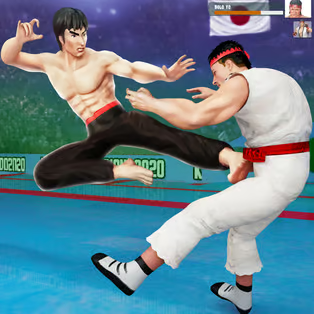
Martial Arts is an arcade fighting game where you face opponents using punches, kicks, blocks, and careful movement. Control your distance, read each attack, build short combinations, and counter when your rival makes a mistake.
Martial Arts
Martial Arts places you in close-range fights where timing matters more than pressing every attack button at once. You control a trained fighter, move into striking distance, block incoming attacks, and look for a safe moment to answer with punches, kicks, or a short combination.
The first opponent may allow a few careless mistakes, but later battles demand more control. A kick thrown from too far away leaves your fighter exposed, while standing too close without defending can lead to several unanswered hits. The challenge is learning when to move forward and when to let the opponent make the first mistake.
Players who enjoy martial arts battles can also try Karate King, where each opponent requires careful movement, defence, and accurate striking.
What Martial Arts Is About
Martial Arts is an arcade fighting game centred on direct combat between trained fighters. Your main objective is to defeat each opponent before your own health bar runs out.
Most matches use a small set of actions:
- Move toward or away from the opponent
- Use quick punches at close range
- Perform kicks with greater reach
- Block or avoid incoming attacks
- Connect several accurate hits
- Use a stronger action when an opening appears
The game simplifies martial arts into an accessible browser challenge. You do not need to learn a long list of realistic techniques before starting. Instead, success comes from understanding attack range, recognising the opponent’s animations, and choosing the correct action at the right moment.
Depending on the version available on Gam-core, the game may include individual battles, a sequence of levels, several selectable fighters, or increasingly difficult opponents.
How Martial Arts Gameplay Feels
A typical match begins with both fighters standing a short distance apart. This gives you time to test movement and see how the opponent reacts when you approach.
Some opponents immediately move forward and begin attacking. Others wait for you to enter their range before responding. Recognising this behaviour can make the rest of the match easier.
The action becomes tense once both fighters are close together. Quick attacks may interrupt a slower move, while a successful block can create a brief chance to counter. Missing an attack has the opposite effect because your fighter may need a moment to recover.
Martial Arts feels best when every action has a reason. Moving backward can make a strike miss. A short punch can test the opponent’s defence. A carefully timed kick can stop an aggressive approach.
For more one-on-one fighting challenges, browse the fighting games collection.
Martial Arts Controls
The exact control layout may differ between browser versions. Check the instructions displayed inside the game before beginning your first match.
A common desktop setup may include:
- Arrow Keys or W, A, S, D: Move the fighter
- Punch key: Perform a quick close-range attack
- Kick key: Use a longer-reaching strike
- Block key: Defend against an incoming attack
- Special key: Use a stronger action when available
- Pause key: Open the menu or stop the match
Mobile versions may provide touchscreen controls around the edges of the display.
Begin by testing one action at a time. Learn how far each punch and kick reaches, how quickly your fighter moves, and how long it takes to recover after missing.
The controls may be easy to remember, but their timing takes several rounds to understand.
Understand Your Attack Range
Every strike needs the correct distance.
Punches are usually quicker and work best when both fighters are standing close together. Their limited reach means they will miss when used too early.
Kicks often cover more distance, making them useful against an approaching opponent. They may also take longer to complete, which creates a larger opening when they miss.
Try to stand near the edge of your useful range. From this position, you can step forward to attack or move backward when the opponent begins a strike.
Avoid walking directly into close range without a plan. Once both fighters are standing beside each other, there is less time to recognise the next attack.
How to Win More Martial Arts Matches
Watch the First Attack
Do not begin every round by rushing forward. Let the opponent reveal how they prefer to fight.
An aggressive opponent may create easy counterattacking opportunities. A defensive fighter may require more patient movement.
Use Quick Attacks to Test Defence
A basic punch is useful for checking how the opponent responds.
They may block, move backward, or immediately attack. Their reaction gives you information for the next exchange.
Keep Combinations Short
Two accurate hits are often safer than a long sequence that continues after the opponent has escaped.
Stop attacking when the opening closes. Returning to movement or defence protects you from an immediate response.
Make Slow Attacks Miss
Stronger strikes usually need more time to finish.
Move out of range as the opponent begins the attack, then step forward while they are recovering.
Change Your Rhythm
Do not always attack after the same movement.
Mix short pauses, quick strikes, retreats, and defensive reactions. An unpredictable rhythm is harder for the opponent to read.
Players who want a wider combination of movement, punches, kicks, blocks, and dodges can also play MMA Fighter.
Why Blocking at the Right Time Matters
Blocking can protect your health, but holding the guard throughout the match is not a complete strategy.
A defensive action is most useful when an attack is actually approaching. Blocking too early may cause the protection to end before the strike arrives.
Watch the opponent’s body movement. A raised leg, forward step, or turning shoulder may show that an attack is beginning.
After a successful block, look for a safe response. The opponent may need a brief moment to recover, giving you time to land a quick attack.
Do not always counter immediately. Some fighters use several strikes in one sequence. Wait long enough to confirm that the combination has ended before lowering your defence.
Movement Can Be Better Than Blocking
Avoiding an attack completely is often more useful than absorbing it through a block.
A small step backward can make a punch miss while leaving you close enough to answer. Moving too far away may keep you safe, but it can also remove your chance to counter.
Try not to retreat in a straight line throughout the entire match. Eventually, you may reach the edge of the arena and lose your movement space.
Return toward the centre whenever the opponent gives you room. A central position provides more escape routes and makes it harder to become trapped.
Movement should remain controlled. Constant jumping or rapid direction changes can make your own fighter harder to manage.
Common Mistakes New Players Make
The most common mistake is pressing attack before reaching the opponent. The fighter performs the full animation, but the strike cannot connect.
Another mistake is repeating the same kick or powerful move. Even a useful attack becomes predictable when used every few seconds.
Players also remain close after finishing a combination. Landing several hits feels successful, but the opponent may recover and begin attacking immediately.
Holding block continuously creates another problem. You may prevent some damage, but you allow the opponent to control the space and timing of the match.
Some players become impatient when an opponent has little health remaining. They rush forward looking for one final hit and lose after walking into a counterattack.
A nearly defeated opponent can still cause damage. Continue using the same careful approach until the match is actually finished.
Reading Different Opponents
Computer-controlled fighters often have recognisable habits.
An aggressive opponent may move forward whenever there is open space. Against this fighter, stepping backward and countering can work well.
A cautious opponent may wait behind a defensive position. Use short attacks and movement to encourage a reaction instead of beginning with a slow, powerful strike.
Another fighter may use kicks whenever you enter a certain range. Move close enough to trigger the attack, retreat before it lands, and respond during the recovery.
Later opponents may combine several behaviours or react more quickly. Do not expect one tactic to work against every character.
Treat the opening seconds of each battle as a chance to learn. Watching one unsuccessful attack can reveal how to handle the rest of the match.
Building Better Combinations
A combination should begin with an attack that has a good chance of connecting.
Quick punches can interrupt movement and create enough time for a second strike. Longer kicks may work better after the opponent has already missed or become unbalanced.
Do not continue the sequence automatically. Watch whether the first hit connects and whether the opponent remains within range.
When they move away, stop attacking and reset your position. Swinging at empty space gives them time to return with a counterattack.
Strong combinations are usually short, accurate, and followed by a safe exit. They are not simply the longest series of buttons you can press.
Players who prefer controlled punches and defensive ring movement can test their timing in Boxing.
Progressing Through Harder Battles
Early opponents usually provide more time to react. They may attack slowly, defend less often, or recover poorly after missing.
Later fighters can become faster and less predictable. They may block repeated attacks, counter missed kicks, or pressure you toward the edge of the arena.
When you lose, think about where most of the damage occurred.
Perhaps you attacked from outside the correct range. You may have blocked too early or remained close after completing a combination.
Correcting one repeated mistake can make the next attempt feel very different.
Progress is not only measured by completing levels. Missing fewer attacks, protecting more health, and recognising opponent patterns earlier are also signs that your play is improving.
Martial Arts Games and Real Training
Martial Arts is fictional browser entertainment. Its controls and animated attacks should not be treated as instructions for practising real fighting techniques.
Real martial arts involve qualified instructors, structured training, controlled practice, and safety rules. The World Karate Federation provides information about organised karate competition, while the International Mixed Martial Arts Federation covers regulated amateur mixed martial arts.
The Olympic overview of martial arts sports also shows how disciplines such as judo, karate, taekwondo, boxing, and wrestling use their own competition structures and rules.
Real techniques should only be practised in a suitable training environment under responsible adult and professional supervision.
What Makes Martial Arts Worth Playing
Martial Arts creates a focused fighting challenge from a manageable set of controls. Players can understand the objective quickly without studying a complicated move list.
The game still provides room for improvement. Better distance control, more accurate blocking, and careful counterattacks can completely change the result of a match.
Short battles make rematches easy. After losing, you can restart and immediately test a different approach.
The game may feel limited for players looking for a long story, detailed character customisation, or realistic martial arts simulation. Most of the experience remains centred on repeated combat encounters.
That direct structure works well for short browser sessions. You enter a match, read the opponent, and try to make more accurate decisions before your health runs out.
For another martial arts-themed challenge with a stronger karate focus, play Karate King.
Who Will Enjoy Martial Arts?
Martial Arts suits players who enjoy one-on-one fighting games, martial arts themes, quick matches, simple controls, and opponents with different attack patterns.
Beginners can start with movement, quick punches, and blocking. They do not need to learn every action during the first fight.
More experienced players can focus on attack range, recovery timing, short combinations, and defensive movement.
The game is also suitable for quick play sessions because battles begin without a long introduction.
Players looking for a detailed combat simulation may find the system basic. Those who want an accessible arcade fighting game are more likely to enjoy its direct style.
Play Martial Arts Free Online
Play Martial Arts free online on Gam-core.com and enter fast battles based on accurate movement, carefully timed attacks, blocking, and counterattacks.
Watch how each opponent approaches, stay near a useful striking distance, and stop attacking when the opening disappears. Winning is not about using the most moves. It is about choosing the right move before the opponent does.


Reviews
There are no reviews yet.