
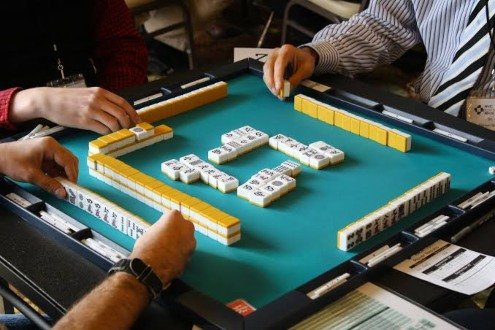


Mahjong
Mahjong is a calm tile-matching puzzle where you remove identical free pairs from a layered layout. Clear upper tiles, open long rows from both sides, protect restricted matches, and plan each choice carefully until the entire board is empty.
Mahjong Classic Tile Matching Puzzle Game
Mahjong is a calm tile-matching puzzle where you remove pairs from a layered board. Each move reveals new tiles, changes the available matches, and can either open the layout or quietly block your progress. The goal is to clear every tile, but only pieces that are uncovered and open on at least one side can be selected.
Players who enjoy traditional board games with patient decision-making may also like Backgammon Gold, where planning several moves ahead is more useful than rushing.
What Is Mahjong?
The browser game commonly called Mahjong is usually Mahjong Solitaire, a single-player matching puzzle that uses symbols inspired by traditional mahjong tiles.
Tiles are arranged face-up in overlapping layers. You remove two matching free tiles at a time until the board is empty or no legal pairs remain.
This puzzle should not be confused with traditional four-player mahjong. Traditional mahjong involves drawing and discarding tiles to build a complete hand, while Mahjong Solitaire focuses on removing exposed pairs from a prepared layout.
Players can find official help for Mahjong through Microsoft’s support pages, including platform and troubleshooting information.
How Mahjong Gameplay Works
A Mahjong board contains tiles placed in rows, stacks, and overlapping layers. Some tiles are immediately available, while others remain blocked by neighbouring or upper tiles.
To remove a pair, both tiles must:
- Display matching symbols
- Have no tile covering them
- Have at least one long side open
Selecting a blocked tile will not remove it, even when an identical tile is visible somewhere else.
After a pair disappears, one or more previously blocked tiles may become free. The board therefore changes after every move.
The main challenge is deciding which matching pair to remove when several options are available. One pair may open several hidden tiles, while another may reveal nothing useful.
What Is a Free Tile?
A free tile can be selected and matched.
In most Mahjong Solitaire versions, a tile is free when nothing is placed directly above it and either its left or right side is open.
A tile surrounded on both sides is blocked. A tile with another piece covering even a small part of its upper surface is also blocked.
This means two identical symbols may be visible without forming a legal pair.
Before selecting a tile, inspect:
- The layer above it
- The tile on its left
- The tile on its right
- Whether removing it will open another piece
Understanding free tiles is more important than memorising every symbol.
The Main Goal
The main objective is to remove every tile from the layout.
You win when the board becomes completely empty. A round may become stuck when tiles remain but no free matching pair is available.
Some digital versions offer shuffle, undo, restart, or hint tools when this happens. These features differ between games and should only be expected when they appear in the current interface.
A successful board usually requires more than choosing the first visible pair. You need to protect future matches and release tiles from the highest or most restricted parts of the layout.
Understanding Mahjong Tile Symbols
Traditional-looking Mahjong Solitaire sets often contain character, bamboo, circle, wind, dragon, flower, and season tiles.
Character Tiles
Character tiles usually display Chinese number symbols together with a character representing ten thousand.
Matching pieces normally need to show the same number and design.
Bamboo Tiles
Bamboo tiles show groups of bamboo sticks. The one-bamboo tile may use a bird design instead of a single stick.
Look carefully because several bamboo tiles can appear similar at first.
Circle Tiles
Circle tiles display groups of round shapes. Count the circles and check their arrangement before selecting a pair.
Wind Tiles
Wind tiles represent east, south, west, and north. Each wind normally matches only the same wind.
Dragon Tiles
The tile set may contain red, green, and white dragons. Dragon tiles must usually be matched with the same dragon type.
Flower and Season Tiles
Some versions allow any flower tile to match another flower and any season tile to match another season. Other versions require identical symbols.
Check the game’s matching feedback before assuming how bonus tiles work.
The classic electronic form commonly uses a 144-tile layout, although digital versions may provide smaller boards and different arrangements.
Choosing Between Matching Pairs
A common Mahjong situation occurs when three or four identical tiles are free at the same time.
Removing the wrong two can leave the remaining pair blocked in different parts of the board.
Suppose four matching circle tiles are visible:
- One is on the highest layer
- One blocks a long row
- Two are already near open edges
Matching the highest tile with the row-blocking tile may be stronger than removing the two easy edge tiles.
The best pair often includes at least one tile that:
- Covers another tile
- Blocks several pieces
- Sits on a high layer
- Restricts access to an inner section
- Has few matching options remaining
Do not treat all matching pairs as equal.
Clear Upper Layers Early
Tiles placed on top reduce access to everything underneath them.
When possible, remove pairs from raised areas before clearing large numbers of easy edge tiles.
This does not mean every high tile must be removed immediately. You still need a legal matching partner.
However, when two possible pairs are equally safe, the pair that lowers the structure usually provides more future choices.
Players who enjoy puzzles based on careful observation can also try Find Easy Hidden Differences, where small visual details decide whether a level is completed.
Work on Long Rows Carefully
Long horizontal rows may contain several blocked tiles between two free ends.
Removing an end tile exposes the next piece in the row. This creates a gradual path toward the centre.
Try to work from both sides instead of clearing one side too quickly. If matching partners become trapped in the same row, an unbalanced approach can leave the centre blocked.
A useful move should ideally open a tile while preserving another legal pair elsewhere.
Do Not Remove Easy Pairs Automatically
Some pairs are easy to notice because both tiles sit on the outside edges.
Removing them may increase the score, but it may not improve the board.
Before selecting an obvious pair, ask:
- Does either tile cover something?
- Will another tile become free?
- Are these symbols needed for a more restricted tile?
- Could this pair be saved for later?
- Is there a higher pair that should be removed first?
A move that opens the board is usually more valuable than one that only removes two exposed pieces.
Main Mahjong Features
- Layered tile layouts: Pieces overlap one another, making tile access part of the puzzle.
- Pair-matching rules: Remove two matching symbols when both tiles are free.
- Single-player gameplay: Solve the board without waiting for another player.
- Mouse and touchscreen controls: Select tiles by clicking or tapping them.
- Multiple possible layouts: Digital versions may include turtle, pyramid, bridge, tower, and other board shapes.
- Hints and shuffling: Some versions help when players cannot find a legal pair.
- Undo support: Certain editions allow recent moves to be reversed.
- Score or time tracking: Boards may record completion time, score, or remaining tiles.
- Clear visual symbols: Different suits and honour tiles make each pair recognisable.
- Short puzzle sessions: Smaller layouts can be completed without a long multiplayer match.
Mahjong Controls
Browser versions normally use simple pointer controls.
| Action | Computer Control | Mobile Control |
|---|---|---|
| Select a tile | Click the tile | Tap the tile |
| Select its match | Click the second tile | Tap the second tile |
| Cancel a selection | Click another area | Tap another area |
| Use a hint | Click the hint button | Tap the hint button |
| Shuffle remaining tiles | Select shuffle | Tap shuffle |
| Undo a move | Select undo | Tap undo |
| Restart the board | Select restart | Tap restart |
| Open settings | Click the menu icon | Tap the menu icon |
Hints, shuffle, undo, and timer controls depend on the version being played.
Using Hints Properly
A hint shows an available pair, but it does not always show the best strategic pair.
The suggested move may be legal without opening an important section.
Use hints when:
- You have scanned the full board
- You cannot identify any legal pair
- Similar symbols are difficult to separate
- You need to confirm whether the board still has a move
After seeing the hint, check whether another pair with the same symbols would be better.
Hints are most helpful as visual assistance, not as a replacement for planning.
When to Use Shuffle
Shuffle rearranges some or all remaining tiles so new pairs become available.
It can rescue a blocked board, but not every version offers unlimited shuffles.
Before using one, confirm that no legal pair remains. A difficult-to-see match may be hidden near the edges or upper layers.
Shuffle can change the puzzle significantly. It may open strong pairs, but it can also remove a layout you were beginning to understand.
Use it when the board is genuinely stuck rather than when the next move is merely difficult to find.
Useful Mahjong Strategies
Remove Tiles That Unlock Several Pieces
A tile covering two or more pieces has high value. Matching it may create several new choices at once.
Balance Both Sides of the Layout
Do not clear only the left or right side. Working evenly can stop matching tiles from becoming trapped in the same section.
Watch Identical Sets of Four
Most standard symbols appear several times. When three or four copies are visible, choose pairs carefully so the remaining copies can still meet later.
Prioritise High and Central Tiles
High tiles cover lower layers, while central tiles often block long rows. Remove them whenever a safe matching option appears.
Memorise Temporarily Blocked Symbols
Notice symbols that are visible but unavailable. When their matching partner becomes free, you can recognise the opportunity quickly.
Check Flower and Season Rules
Do not assume every bonus tile needs an identical image. Test how the current version handles these groups.
Keep Several Pair Options Open
Using every available pair immediately may leave the board with no choices. Save flexible edge pairs while working on restricted areas.
Slow Down Before a Major Choice
Mahjong Solitaire usually does not require fast reactions. Compare all visible pairs before committing to a move.
Common Mahjong Mistakes
Matching the First Pair You Notice
The first legal pair may not reveal anything useful. Study the board before selecting it.
Ignoring Covered Tiles
A tile can look open while another piece partly covers it. Check the upper layer carefully.
Clearing One Side Too Quickly
An uneven board can trap matching pieces in the opposite section.
Forgetting About Four Identical Tiles
Using two convenient copies may leave the other two blocked with no way to meet.
Depending Too Much on Hints
Hints normally identify legal moves rather than explain the best long-term choice.
Saving Every Easy Pair
Keeping flexible pairs is useful, but saving too many can prevent the board from changing. Use them when they release important tiles.
Confusing Similar Symbols
Bamboo, character, and circle tiles can look alike when viewed quickly. Check both the number and design.
Mahjong Solitaire and Traditional Mahjong
Mahjong Solitaire and traditional Mahjong share tile artwork, but their rules are very different.
| Mahjong Solitaire | Traditional Mahjong |
|---|---|
| Usually one player | Commonly four players |
| Match exposed pairs | Draw and discard tiles |
| Clear a layered layout | Build a legal hand |
| No opponent required | Players compete directly |
| Usually simple scoring | Scoring varies by regional rules |
| Common as a computer puzzle | Common as a tabletop and online game |
Traditional Mahjong uses suits, winds, dragons, sets, pairs, drawing, and discarding. Regional forms include Chinese, Hong Kong, Japanese Riichi, American, and other rule systems.
Players interested in traditional competition rules can consult the Mahjong Competition Rules published through the European Mahjong Association.
Graphics and Sound
Mahjong games usually use a top-down or slightly angled view so players can see the layered board.
Clear shadows help show whether one tile sits above another. This visual depth is important because a tile’s position decides whether it is selectable.
Traditional tile sets use detailed Chinese symbols, while themed versions may replace them with animals, food, flowers, jewels, or other pictures.
Sound effects commonly indicate tile selection, successful matches, mistakes, hints, and board completion. Audio is not required, so the puzzle remains playable in quiet settings.
Learning Curve
The basic rule is easy to learn: find two matching free tiles and remove them.
The deeper challenge comes from understanding how each pair changes future access.
Beginners often focus on visible matches. More experienced players watch the structure underneath those matches and protect useful pairs for later.
Mahjong does not normally require fast reflexes. Players can inspect the symbols and consider several moves before selecting a pair.
For another quiet game based on organising pieces, Rummy Offline Board asks players to arrange cards into valid sets and runs.
Who Should Play Mahjong?
Mahjong is suitable for players who enjoy tile puzzles, pattern recognition, calm gameplay, and boards that can be solved through patient choices.
It can work well for short breaks because a puzzle begins without a long tutorial. Larger layouts also provide longer sessions for players who want a more involved challenge.
The game may appeal to people who enjoy:
- Matching symbols
- Clearing layered boards
- Planning several moves ahead
- Improving completion times
- Solving puzzles without fast reactions
Players looking for live action, character movement, storytelling, or direct competition may find Mahjong Solitaire too quiet.
Those who prefer two-sided board strategy can try Tic Tac Toe AI 5 in a Row, where every placement can create or block a winning line.
Honest Strengths and Limitations
| Strengths | Possible Limitations |
|---|---|
| Matching rules are easy to understand | Similar tile symbols can confuse beginners |
| No fast reactions are required | Some layouts can become blocked |
| Layered boards create meaningful choices | The basic matching loop may feel repetitive |
| Mouse and touchscreen controls work naturally | Features differ between digital versions |
| Suitable for short or longer sessions | Shuffle and undo may be limited |
| Helps practise visual attention | A legal pair is not always a strong move |
| Different layouts add variety | Traditional Mahjong players may expect different rules |
| Can usually be played alone | No direct multiplayer in standard Mahjong Solitaire |
Mahjong Game Information
| Detail | Information |
|---|---|
| Game title | Mahjong |
| Common digital format | Mahjong Solitaire |
| Genre | Tile-matching puzzle |
| Main mode | Single-player |
| Main objective | Remove every matching pair |
| Traditional layout size | Often 144 tiles |
| Main rule | Tiles must be uncovered and open on one side |
| Controls | Mouse, trackpad, or touchscreen |
| Typical features | Hint, shuffle, undo, timer, and multiple layouts |
| Difficulty | Simple rules with strategic board management |
Frequently Asked Questions
What type of game is Mahjong?
The browser version commonly called Mahjong is usually a single-player tile-matching puzzle. Players remove matching free tiles until the board is empty.
How do I remove Mahjong tiles?
Select two matching tiles. Both pieces must be uncovered and have at least one open side.
What is a free Mahjong tile?
A free tile has no piece covering it and is not blocked on both its left and right sides.
Do all Mahjong tiles need to be identical?
Most standard tiles must be identical. Some games allow any flower to match another flower and any season to match another season.
Is Mahjong Solitaire the same as traditional Mahjong?
No. Mahjong Solitaire is a pair-matching puzzle, while traditional Mahjong is commonly a multiplayer game based on drawing, discarding, and forming a complete hand.
Can Mahjong be played alone?
Yes. Mahjong Solitaire is designed mainly for one player.
What happens when no pairs remain?
The board becomes stuck. Depending on the version, you may be able to shuffle the tiles, undo earlier moves, restart, or begin another layout.
Does Mahjong have a time limit?
Some versions use a timer, while others allow unlimited thinking time. Check the interface before starting.
How many tiles are on a Mahjong board?
A traditional Mahjong Solitaire layout often uses 144 tiles, but digital boards may contain fewer tiles or use custom arrangements.
What is the best beginner strategy?
Clear high tiles, open long rows from both sides, protect restricted matching pairs, and avoid removing easy edge pairs without checking what they reveal.
Can I play Mahjong on mobile?
Many browser and app versions support touchscreen controls. Players normally select tiles by tapping them.
Is every Mahjong board solvable?
Not every random arrangement is guaranteed to be solvable. Some digital versions create solvable layouts or provide undo and shuffle tools.






Reviews
There are no reviews yet.