
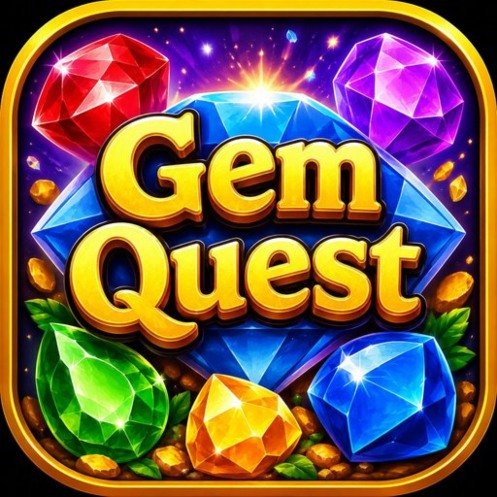


Gem Quest
Gem Quest is a fast falling-jewel puzzle where you move and rotate colorful columns before they land. Create vertical and diagonal matches, trigger chain reactions, survive Arcade Mode, chase timed scores, and remove highlighted gems across Challenge levels.
Gem Quest Fast Falling Jewel Puzzle Game
Gem Quest is a quick puzzle game where colorful jewel columns fall from the top of the board. Instead of swapping pieces already placed on the grid, you move and rotate each falling column before it lands.
Your goal is to align three or more matching gems vertically or diagonally. Successful matches disappear and create space for more pieces. The rules are easy to understand, but the game becomes tense when columns fall faster and the board begins filling from several directions.
What Is Gem Quest?
Gem Quest is a falling-gem puzzle game developed by Hubusoft. It combines matching rules with the pressure of positioning pieces before they reach the bottom of the board.
Each falling piece contains a small column of gems. You can move the full column left or right and rotate the order of the jewels inside it. Once it lands, any valid group of matching gems is removed.
The game includes Arcade, Time Trial, and Challenge modes. Arcade continues until the gem stack reaches the top, while Time Trial asks you to earn as many points as possible before the clock ends. Challenge levels introduce marked gems and three-star goals.
Players who enjoy planning where each piece should land can also try Chain Cube 2048 3D Merge, where matching number cubes creates larger values.
How Gem Quest Gameplay Works
A new column enters from the top of the screen. Before it lands, you can move it across the board and rotate the gems inside it.
The order of the gems matters. A blue jewel at the top of the column may be useless in its current position, but rotating the column can move it to the bottom and complete a match.
Once the column reaches the existing stack, it becomes fixed. Matching groups disappear, nearby gems fall into the empty spaces, and another column enters the board.
A normal round follows a clear pattern:
- Check the colors in the falling column.
- Look for unfinished matches on the board.
- Move the column above the best position.
- Rotate the gems into a useful order.
- Let the column land.
- Watch for matches and chain reactions.
- Prepare for the next column.
- Keep the stack away from the top.
The early part of a round gives you plenty of time to think. Later, the faster falling speed makes hesitation much more costly.
Matching Three or More Gems
A match is created when at least three gems of the same type line up correctly.
Gem Quest focuses on vertical and diagonal combinations. This makes the board feel different from match-three games based mainly on horizontal swaps.
A vertical match is often easier to see because the gems sit directly above one another. Diagonal matches require more attention because the colors may be spread across neighboring columns.
Matching more than three gems can produce a larger score and remove additional space. It can also cause other jewels to fall into matching positions.
Do not focus only on the gem at the bottom of the falling column. Every jewel inside the piece may complete a different part of the board.
Rotating Falling Gem Columns
Rotation changes the order of the jewels without moving the full column to another lane.
Imagine a falling piece containing red, green, and blue gems. One rotation may place blue at the bottom, red in the middle, and green at the top. Rotating again changes the order once more.
This allows one falling column to fit several possible positions.
Before rotating, inspect the board from the bottom upward. Decide which color needs to land first, then place that gem at the bottom of the column.
Avoid rotating repeatedly without checking the result. The piece continues falling while you change it, and too many unnecessary inputs can leave no time for accurate placement.
Reading the Board Before a Piece Lands
The safest time to plan is as soon as the new column appears.
Look for pairs of matching gems first. A pair needs only one additional jewel to disappear, making it the easiest scoring opportunity.
Next, check for diagonal patterns. Two matching gems may sit one row apart in neighboring columns, allowing the correct placement to complete the line.
You should also notice dangerous areas. A column that is already close to the top should not receive more pieces unless the landing creates an immediate match.
When no direct match is available, place the column where it creates a useful setup for the future.
Creating Chain Reactions
A chain reaction happens when one match removes gems and causes another group to form automatically.
For example, removing three green gems may allow several red gems above them to fall together. The red group then disappears without another piece being placed.
Chains can provide more points and clear a large section of the board.
They are not always easy to predict, but you can improve your chances by checking the colors above the match you plan to create.
Ask what will fall after those gems disappear. When two matching jewels are separated only by the group being removed, a chain may be possible.
Do not become so focused on building a large chain that the board reaches the top. A simple match that creates space is often the safer move.
Arcade Mode
Arcade is the main survival-style mode in Gem Quest.
Columns continue falling until the stack reaches the top of the playing area. Your goal is to destroy as many gems as possible and build a high score before the board becomes full.
The mode includes different difficulty settings based on the number of jewel types available:
| Difficulty | Jewel Variety |
|---|---|
| Easy | Five gem types |
| Medium | Six gem types |
| Hard | Seven gem types |
Fewer colors make matches easier to create because the same gems appear more often. Additional colors reduce that chance and make the board harder to organize.
Easy mode is useful for understanding rotation and diagonal matching. Hard mode is better for players who can already read several future placements quickly.
Time Trial Mode
Time Trial gives you a fixed amount of time to earn the highest score possible.
Available sessions include one, three, five, and ten-minute challenges in the verified mobile version.
A one-minute game rewards immediate decisions. There is little value in preparing a complicated chain that will not be completed before the timer ends.
Longer sessions require more board management. You still need to score quickly, but allowing the stack to become messy can make the final minutes much harder.
Keep the board lower during longer rounds. A clean playing area gives you more placement options when the falling speed increases.
Time Trial is useful when you want a complete session with a predictable length.
Challenge Mode
Challenge Mode contains individual levels with specific goals.
Rather than clearing any available jewels, you may need to destroy highlighted gems that use a different background. Completing the main task finishes the level, while stronger results can earn up to three stars.
Highlighted gems may begin in awkward positions. You often need to build matching colors around them before they can be removed.
Do not clear unrelated parts of the board without a reason. Every falling column should either support the objective or prevent the stack from becoming dangerous.
Some levels reward efficiency. Reaching the target with fewer wasted pieces can lead to a better result.
Main Gem Quest Features
- Falling-column puzzles: Groups of jewels enter from the top and must be positioned before landing.
- Rotation controls: Players can change the order of gems inside each falling column.
- Vertical and diagonal matches: Align three or more matching jewels to remove them.
- Chain reactions: Cleared gems can cause new combinations to form automatically.
- Arcade mode: Continue playing until the growing stack reaches the top.
- Three Arcade difficulties: Easy, Medium, and Hard use an increasing number of gem types.
- Timed challenges: Choose short or longer sessions and earn as many points as possible.
- Objective levels: Challenge Mode asks players to remove highlighted gems.
- Three-star results: Stronger Challenge performances can earn better ratings.
- Leaderboard support: The original mobile version includes Google Play Games competition across several score categories.
Gem Quest Controls
Gem Quest was designed for touchscreen and gamepad input.
| Action | Common Control |
|---|---|
| Move the column left | Swipe left or use directional input |
| Move the column right | Swipe right or use directional input |
| Drop or move the column | Swipe or use the gamepad |
| Rotate the gems | Use the rotate input or touchscreen gesture |
| Pause the round | Select the pause button |
| Restart | Choose restart from the menu |
| Select a mode | Tap the desired mode |
| Change settings | Open the settings menu |
The verified mobile version allows players to move and rotate columns with touch gestures or a compatible gamepad. Touch movement can also be disabled through the settings.
The exact layout may differ on the version hosted by Gam-core, so check the displayed control panel before beginning.
Keeping the Board Low
The main danger is allowing one or more columns to reach the top.
A board does not need to be completely full to become difficult. One tall section can limit where future pieces can safely land.
Try to spread unmatched gems across the board instead of building a narrow tower.
When one column becomes too high, look for any match that can reduce it. Even a small clear can create enough space for another piece.
Do not add to the tallest column simply because it contains a useful color. Check whether the same piece can support a match in a safer part of the board.
A balanced height gives you more time to rotate and place future columns.
Planning With the Bottom Gem
The bottom gem makes contact with the board first, so it usually has the biggest effect on placement.
Check which color needs to land at the lowest available position. Rotate the falling piece until that color sits at the bottom.
The middle and top gems still matter. They may complete diagonal matches or prepare combinations for the next turn.
A good placement uses more than one part of the column. The bottom jewel may complete a match while the upper pieces create useful pairs.
When no full match is possible, prioritize a landing that places similar colors near one another without blocking the board.
Using Diagonal Matches
Diagonal combinations are easy to miss when attention stays on individual columns.
Scan the board in both diagonal directions. Look for two matching gems with an open position that can complete the group.
A diagonal setup may involve different heights. The falling column can fill the missing space if its bottom gem lands at the correct level.
After each clear, inspect the board again. Falling jewels may create new diagonal opportunities that were not present before.
Players who prefer aiming and matching colorful objects can also play Farm Fruit Pop Bubble, where groups are cleared by shooting matching fruit bubbles.
Deciding When to Drop Quickly
Dropping a piece early can speed up scoring, especially during Time Trial.
However, fast placement is useful only when you have already selected the correct position and rotation.
Do not force every column downward immediately. A rushed mistake can create several unmatched gems that take much longer to remove.
During the opening part of Arcade Mode, use the available time to build a clean board. Increase your speed gradually as the natural falling rate becomes faster.
In Time Trial, quick drops are more useful when the placement creates an obvious match. Slow down for complicated columns that affect several areas.
Recovering From a Crowded Board
A crowded board does not always mean the round is over.
Stop looking for perfect chains and focus on immediate space. Clear any group available near the tallest columns.
Place awkward pieces in lower sections instead of making the dangerous area even higher.
You may need to ignore a promising setup if it requires several future pieces. Survival becomes more important than maximum points when the stack is close to the top.
One successful chain can reopen a large part of the board, so continue looking at the colors beneath the highest sections.
Common Gem Quest Mistakes
Watching Only One Color
A falling column contains several gems. Focusing on one may cause the other two to land in poor positions.
Forgetting Diagonal Matches
Vertical groups are easy to notice, but diagonal clears can provide equally useful space and points.
Rotating Too Many Times
Repeated rotation wastes the limited time available before landing. Decide which gem belongs at the bottom first.
Building One Tall Column
A narrow tower can end the round while the rest of the board remains mostly empty.
Chasing Large Chains Too Early
Long setups are satisfying, but they can create unnecessary risk before the board is stable.
Dropping Every Piece Immediately
Fast play helps only when the placement is correct. One rushed column can block several future matches.
Ignoring Highlighted Gems
In Challenge Mode, clearing normal jewels may not complete the objective. Keep the marked pieces at the center of the plan.
Using the Same Pace in Every Mode
Arcade rewards survival, while Time Trial places more value on quick scoring. Challenge Mode is based on the level objective.
Tips for Playing Gem Quest
Read the Full Falling Column
Check all gem colors before moving. One piece may support several possible matches.
Rotate Before Reaching the Stack
Make the main rotation early so only a small adjustment is needed near the landing position.
Complete Existing Pairs
Two matching gems are the easiest starting point for a clear.
Keep Heights Balanced
Use lower columns whenever no immediate match is available.
Scan Both Diagonal Directions
A match may run upward to the left or upward to the right.
Watch What Will Fall
Before completing a match, look at the gems above it and check for a possible chain.
Change Strategy by Mode
Clear space in Arcade, score efficiently in Time Trial, and focus on marked gems in Challenge Mode.
Use Easy Mode for Practice
The smaller color variety makes it easier to understand rotation and board movement.
Stay Calm Near the Top
Random movement usually makes a crowded board worse. Find the quickest reliable clear near the tallest area.
Graphics and Presentation
Gem Quest uses bright jewel colors that make matching groups easy to identify.
The board remains simple so players can follow falling columns, completed matches, and chain reactions without visual clutter.
Effects appear when gems disappear or several combinations happen together. These animations provide clear feedback without hiding the next piece for too long.
Challenge gems use a different background, helping them stand apart from ordinary jewels.
The presentation is designed for quick reading. This becomes important during faster Arcade rounds and short Time Trial sessions.
Difficulty and Learning Curve
Gem Quest is easy to begin because the central rule is familiar: connect at least three gems of the same type.
The falling-column system creates the deeper challenge. You must think about movement and rotation before the piece becomes fixed.
Easy Arcade mode gives matching colors more frequently. Medium and Hard add more jewel types, making useful combinations less predictable.
Challenge Mode can be harder in a different way because a level may require one specific group to be removed.
Players improve by reading the entire board rather than reacting only to the current falling piece.
Who Should Play Gem Quest?
Gem Quest is a good choice for players who enjoy falling-block puzzles, jewel-matching games, quick scoring, and compact mobile challenges.
Arcade Mode suits players who like chasing a personal best. Time Trial works well for short sessions, while Challenge Mode provides clearer level goals.
The game may also appeal to players who enjoy planning under light time pressure. Rotating a piece correctly requires thought, but the controls remain simple.
Players looking for a story, character development, open maps, or multiplayer battles may find the experience too focused. Gem Quest is mainly about board management and improving scores.
More casual, puzzle, and strategy titles are available in the Gam-core games collection.
Honest Strengths and Limitations
| Strengths | Possible Limitations |
|---|---|
| Falling columns create a distinct matching challenge | Later speeds may feel demanding for relaxed players |
| Rotation adds useful control over every piece | One mistaken placement can affect several future turns |
| Three modes support different play styles | The core action remains focused on matching gems |
| Difficulty settings help new players practise | Additional gem colors can make the board crowded quickly |
| Chain reactions provide satisfying score moments | Large chains partly depend on available pieces |
| Short sessions work well on mobile | Limited story or character progression |
| Challenge levels provide specific goals | Some objectives may require repeated attempts |
| Touch and gamepad controls are supported | Availability and controls may vary by platform |
Gem Quest Game Information
| Detail | Information |
|---|---|
| Game title | Gem Quest |
| Developer | Hubusoft |
| Genre | Falling-block and gem-matching puzzle |
| Game mode | Single-player |
| Main objective | Align three or more matching gems |
| Match directions | Vertical and diagonal |
| Modes | Arcade, Time Trial, and Challenge |
| Arcade difficulties | Easy, Medium, and Hard |
| Controls | Touchscreen or compatible gamepad |
| Original verified platform | Android |
| Price model | Free in the verified mobile version |
Frequently Asked Questions
What type of game is Gem Quest?
Gem Quest is a falling-column puzzle game where players move and rotate jewel groups to create vertical or diagonal matches.
How do I remove gems?
Align at least three jewels of the same type vertically or diagonally. The completed group disappears from the board.
Can I rotate the falling gems?
Yes. Rotation changes the order of the jewels inside the falling column.
What is Arcade Mode?
Arcade Mode continues until the gem stack reaches the top of the board. The objective is to clear gems and earn the highest possible score.
What is Time Trial Mode?
Time Trial gives you a fixed session of one, three, five, or ten minutes. You need to score as many points as possible before time ends.
How does Challenge Mode work?
Challenge Mode contains individual levels where highlighted gems must be removed. A strong performance can earn up to three stars.
What is the difference between Arcade difficulties?
Easy uses five jewel types, Medium uses six, and Hard uses seven. More colors make useful matches harder to create.
Does Gem Quest include chain reactions?
Yes. Removing one group can cause other gems to fall together and create additional automatic matches.
Can I play Gem Quest with a gamepad?
The verified Android version supports gamepad controls as well as touchscreen movement and rotation.
Is Gem Quest multiplayer?
The main gameplay is single-player. The original mobile version also supports leaderboard score comparisons.
What ends an Arcade round?
The round ends when the stacked gems reach the top of the board.
Is Gem Quest suitable for beginners?
Yes. Easy Arcade mode is a useful place to learn movement, rotation, vertical matches, and diagonal combinations.





Reviews
There are no reviews yet.