
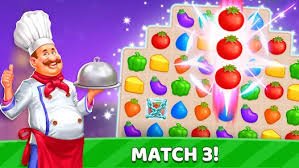


Match 3 Games
Match 3 Games are colourful tile puzzles where you swap neighbouring pieces to create lines of three or more. Build special items, combine powerful effects, clear difficult blockers, manage limited moves, and focus on each level’s objective rather than making random matches.
Match 3 Games
Match 3 Games are tile-matching puzzles where you move colourful pieces to form rows or columns of at least three identical items. A successful match clears those pieces, lets new tiles fall into the empty spaces, and may start a chain reaction. The controls are easy to learn, but later boards require careful move planning, special-piece combinations, and close attention to the level objective.
Players who enjoy combination-based puzzles may also like Chain Cube 2048 3D Merge, where matching numbered cubes creates larger values instead of clearing coloured tiles.
What Are Match 3 Games?
Match 3 Games are puzzle games built around arranging three or more matching pieces. The board may contain gems, sweets, fruit, flowers, shapes, animals, or other themed objects.
In the most familiar format, you swap two neighbouring tiles. The move is accepted when it creates a horizontal or vertical match. The matched pieces disappear, tiles above them fall downward, and new pieces enter the board.
Electronic Arts describes Bejeweled as the match-3 franchise that helped establish this style of gem-matching play. Modern games have added level objectives, moving boards, special tiles, obstacles, boosters, events, and story progression.
The official Match 3 Games page for Bejeweled provides a useful example of how the genre combines simple matching with timed modes, boosts, special gems, and changing challenges.
How Match 3 Games Work
A normal level begins with a grid filled with several types of tiles. You select one piece and swap it with an adjacent tile.
The move must normally create a line of three or more matching items. Diagonal matches are not usually accepted unless the current game specifically allows them.
After a valid match:
- The matching pieces are removed.
- Empty spaces appear on the board.
- Tiles above fall into those spaces.
- New tiles enter from the top.
- Any new automatic matches are cleared.
- Control returns to the player.
This repeated falling and clearing is known as a cascade or chain reaction. A single move can sometimes cause several matches without further input. The standard system of swapping adjacent tiles, removing matches, and allowing pieces above to fall is used by major games such as Candy Crush Saga and Bejeweled.
The Main Goal
Matching three pieces is the basic action, but it is not always the complete objective.
Depending on the level, you may need to:
- Reach a target score
- Collect a stated number of colours
- Clear covered squares
- Remove blockers
- Drop objects to the bottom
- Spread a material across the board
- Rescue trapped items
- Break boxes or ice
- Complete the board within limited moves
- Survive until a timer ends
Read the objective before making the first move. A large match can look useful while doing nothing to complete the actual task.
Modern titles such as Candy Crush Saga organise play into increasingly challenging levels with specific goals, boosters, and limited resources.
Basic Match Types
Different match shapes can create different results.
Three-Piece Match
A line of three matching tiles is the basic move.
It removes the pieces but may not create a special item. These small matches are useful when they affect an obstacle, collect a required colour, or prepare a stronger move.
Four-Piece Match
Matching four identical pieces in a straight line commonly creates a special tile.
Depending on the game, this tile may clear an entire row or column when activated.
Five-Piece Match
A straight line of five matching pieces often creates a powerful colour-clearing item.
When combined with a normal tile, it may remove every piece of that colour from the board.
T or L-Shaped Match
Matching pieces in a T or L formation commonly produces an area-clearing item.
This type of special piece may remove surrounding tiles when activated.
Square Match
Some Match 3 Games reward a two-by-two square. The result may be a flying helper, fish, propeller, or another object that targets an important area.
These results are not universal. Check the current game’s tutorial because the same shape can create different pieces in different titles.
Special Pieces
Special pieces clear more of the board than a normal three-tile match.
Row Clearer
This piece removes every tile across one horizontal row.
It is useful when blockers or objectives are spread across the width of the board.
Column Clearer
This piece clears a full vertical column.
It can help move ingredients or other objects downward.
Area Blast
An area-clearing piece removes nearby tiles in a small radius.
Use it beside thick obstacles or groups of required items.
Colour Clearer
A colour-clearing item removes every normal tile matching the selected colour.
Its value increases when many pieces of that colour are visible.
Targeting Piece
Some games create a helper that travels toward an objective, blocker, or difficult square.
The destination may be selected automatically rather than controlled by the player.
The exact names and effects vary. Bejeweled Stars, for example, includes special powers, movable gem-filled clouds, currents, cascades, and objective-based boards.
Combining Special Pieces
Two special pieces can often be swapped together to create a stronger effect.
Possible combinations include:
| Combination | Common Result |
|---|---|
| Two line clearers | Clears a row and column |
| Line clearer and area blast | Clears several rows and columns |
| Two area blasts | Creates a larger explosion |
| Colour clearer and normal tile | Removes one colour |
| Colour clearer and line clearer | Changes one colour into line-clearing pieces |
| Two colour clearers | Clears most or all normal tiles |
The exact result depends on the game. Do not assume that every title uses the same combinations.
When two special pieces are close together, avoid activating one accidentally with a smaller match. Moving them into position may be worth spending an extra turn.
Match Near the Bottom
A match near the lower part of the board causes more pieces above it to move.
That movement can create additional automatic matches and bring useful pieces into better positions.
Bottom matches are especially helpful when:
- The level requires a high score
- You need chain reactions
- The board has no difficult upper blocker
- Objects must fall downward
- You are trying to create new possible moves
However, the bottom-first rule should not replace the level objective. When a blocker at the top is preventing progress, matching beside that blocker may be more important.
Read the Board Before Moving
Many Match 3 Games show a suggested move after a few seconds. The suggested swap is normally a legal move, but it may not be the strongest one.
Before accepting it, check for:
- A possible four-piece match
- A possible five-piece match
- A T or L shape
- Two special pieces that can be combined
- A match beside an important blocker
- A move that drops an objective item
- A better match near the bottom
- A move that prepares a special piece
Take a few seconds to scan the full board. Match-three puzzles have simple rules, but research has shown that planning optimal moves in general match-three systems can become computationally difficult.
Limited Moves
Many level-based Match 3 Games provide a fixed move count.
Every swap uses one move, whether it clears three tiles or creates a large combination. This makes efficiency more important than clearing pieces randomly.
Before moving, ask:
- Does this help the objective?
- Does it create a special piece?
- Does it damage a blocker?
- Does it prepare a stronger second move?
- Does it improve the board position?
A move that does none of these may waste part of the limit.
Watch the counter throughout the level. Do not wait until only two moves remain before checking which objective is unfinished.
Timed Modes
Some Match 3 Games replace move limits with a countdown.
Timed play rewards quick pattern recognition, but uncontrolled swapping can still reduce the final score.
A useful approach is to:
- Scan while pieces are falling
- Make clear matches without long pauses
- Prioritise special pieces
- Use combinations when they are immediately available
- Avoid spending too much time on one difficult area
- Keep the cursor or finger near the centre of the board
EA’s Bejeweled series includes both relaxed puzzle play and faster timed formats such as Bejeweled Blitz.
Blockers and Obstacles
Later levels often place obstacles between the player and the objective.
Common blockers include:
- Ice or jelly covering a square
- Boxes requiring one or more hits
- Chains locking a tile in place
- Walls that prevent swaps
- Chocolate-like pieces that spread
- Empty spaces that cannot hold tiles
- Containers hiding required objects
- Portals that move pieces between areas
- Generators that release new blockers
- Layers that must be removed separately
Read how a new obstacle behaves before spending several moves testing it.
Some blockers are cleared by matching directly on them. Others require a match beside them. Multi-layered blockers need repeated hits.
Spreading obstacles should normally be controlled early. Allowing them to cover more useful squares can make the final moves much harder.
Cascades and Chain Reactions
A cascade happens when falling pieces create another match automatically.
Cascades can:
- Increase the score
- Collect additional objective pieces
- Damage several blockers
- Create unexpected special pieces
- Rearrange a difficult board
- Complete a level without another move
You cannot predict every new tile entering from the top, but you can improve the chance of a cascade by clearing lower pieces and creating larger open areas.
Do not depend entirely on luck. A planned match that directly affects the objective is safer than hoping random falling tiles will solve the board.
Level Objectives Matter More Than Score
A high score does not always complete a level.
A player may create several large combinations and still fail because one covered square or trapped object remains.
Check the objective panel after every few moves. When one part is nearly complete, shift attention to the harder remaining task.
For example, a level may require both:
- Collecting twenty blue tiles
- Clearing six covered squares
Blue tiles may be easy to collect through cascades. The covered squares should receive more direct attention because they are restricted to specific positions.
Match 3 Games Controls
Most browser versions use a mouse or touchscreen.
| Action | Computer Control | Mobile Control |
|---|---|---|
| Select a tile | Click | Tap |
| Swap tiles | Click and drag or select two neighbours | Swipe toward the adjacent tile |
| Activate a special piece | Swap or match it | Swipe or tap as instructed |
| Use a booster | Click its icon | Tap its icon |
| Pause | Select the menu button | Tap the menu button |
| Restart | Choose restart from the menu | Tap restart |
| Continue after a level | Click next | Tap next |
Some games let you select one tile and then click a neighbouring tile. Others require a short drag.
A swap is commonly rejected when it does not create a match, although some puzzle variations allow non-matching moves.
Boosters and Power-Ups
Boosters provide extra help before or during a level.
Common examples include:
- Starting with special pieces
- Removing one selected tile
- Clearing a row
- Clearing a column
- Shuffling the board
- Adding extra moves
- Breaking one blocker
- Activating several random pieces
Use boosters to solve a specific problem rather than selecting them automatically.
A single-tile remover is valuable when one hard-to-reach square remains. It provides less value at the beginning of an open board.
Some free-to-play Match 3 Games sell optional items or offer advertising-based rewards. Candy Crush Saga’s official store listings state that the core game is free while some optional items require payment.
Lives and Failed Levels
Some Match 3 Games use a lives system. Failing a level may remove one life, while lives return after waiting or through another supported reward system.
Before restarting, identify why the previous attempt failed.
Ask:
- Did I ignore the main objective?
- Did I spend too many moves making normal matches?
- Was one blocker left until too late?
- Did I activate a special piece too early?
- Did I miss a useful combination?
- Was the opening layout poor?
Repeating the same moves without changing the plan rarely solves the underlying problem.
Useful Match 3 Games Strategies
Study the Objective First
Know whether the level is about score, collection, blockers, falling items, or another task.
Search for Five-Piece Matches
A five-tile line often produces one of the strongest pieces available.
Build Special Pieces Close Together
Two combined special items may clear more than several separate activations.
Work Near Difficult Corners
Corners and isolated squares have fewer neighbouring tiles, making them harder to clear later.
Remove Blockers Early
Open the board before it becomes crowded with restricted spaces.
Plan the Second Move
After finding a valid swap, check what the board may look like afterward.
Use the Bottom Carefully
Lower matches create more falling movement, but direct objective moves still come first.
Protect Useful Setups
Do not break a nearly completed four-piece or five-piece pattern for a small immediate match.
Save Boosters
Keep limited assistance for levels where one particular obstacle repeatedly causes failure.
Stop and Rescan
When no good move is visible, look away briefly and inspect the board from top to bottom again.
Common Match 3 Games Mistakes
Making the First Available Match
A legal move is not automatically an effective move.
Ignoring the Level Goal
Clearing many tiles can still lead to failure when the required object remains untouched.
Activating Special Pieces Separately
Combining two special pieces may produce a much stronger result.
Waiting Too Long to Clear Corners
Restricted edge squares often become difficult during the final few moves.
Following Every Suggested Move
A hint shows a possible swap, not necessarily the best strategic option.
Spending Boosters Too Early
Save limited tools until you understand which part of the level is causing trouble.
Watching Only One Area
A stronger combination may be available on the opposite side of the board.
Using Large Matches Away From Objectives
A special piece is useful only when its position or future movement supports the goal.
Forgetting How Pieces Fall
Check which tiles will move after a match and whether the change will help the next turn.
Graphics and Sound
Match 3 Games usually use bright colours and clear tile shapes so pieces can be identified quickly.
Good visual design separates colours through shape, symbols, patterns, or outlines. This is particularly helpful when players have difficulty distinguishing similar shades.
Animations show matched pieces disappearing, new tiles falling, special items activating, and objectives being completed.
Sound effects confirm matches, cascades, power-ups, remaining moves, and level completion. Audio is normally optional because all essential information is displayed visually.
EA’s Bejeweled Stars uses moving gem systems, themed boards, powers, rewards, and level-based challenges as part of its presentation.
Difficulty and Learning Curve
The basic rule of matching three pieces can be understood quickly.
Difficulty increases through:
- Lower move limits
- More tile colours
- Restricted board shapes
- Multi-layer blockers
- Several objectives in one level
- Hard-to-reach corners
- Spreading obstacles
- Moving board sections
- Special tile rules
- Fewer useful starting moves
Later levels test planning rather than control speed. The player must understand how one swap affects several parts of the board.
The official Royal Match site provides another example of a level-based match-three game that uses themed pieces and castle-related puzzle boards.
Who Should Play Match 3 Games?
Match 3 Games suit players who enjoy colourful puzzles, short levels, pattern recognition, and simple controls with gradually increasing difficulty.
They may appeal to players who like:
- Rearranging tiles
- Creating chain reactions
- Solving move-limited boards
- Combining special pieces
- Completing daily challenges
- Improving scores
- Playing in short sessions
- Returning to long level maps
Players looking for a visual puzzle without tile swapping can try Find Easy Hidden Differences, where progress comes from comparing two pictures and finding small changes.
Those who prefer clues and connected room puzzles can play Escape Game Basic.
More casual, puzzle, action, strategy, and racing titles are available through the Gam-core games library.
Honest Strengths and Limitations
| Strengths | Possible Limitations |
|---|---|
| Basic controls are easy to learn | Later levels can become difficult |
| Short levels suit quick sessions | The matching loop may feel repetitive |
| Special pieces add strategic choices | Effects differ between games |
| Cascades create satisfying board changes | New falling tiles include uncertainty |
| Many level objectives provide variety | Some objectives depend on specific board positions |
| Mouse and touchscreen controls work naturally | Small screens may make tiles harder to see |
| Players can improve through planning | Suggested moves may distract from better choices |
| Boosters can help with difficult boards | Free-to-play versions may include optional purchases |
| No fast character movement is required | Timed modes may not suit every player |
| Bright graphics make matches clear | Similar colours may be hard to distinguish without symbols |
Match 3 Games Information
| Detail | Information |
|---|---|
| Game title | Match 3 Games |
| Genre | Tile-matching puzzle |
| Main objective | Match three or more identical pieces |
| Common movement | Swap neighbouring tiles |
| Standard directions | Horizontal and vertical |
| Common modes | Level-based, timed, endless, and score challenge |
| Typical objectives | Collect tiles, clear blockers, reach scores, or move objects |
| Main controls | Mouse, keyboard shortcuts, or touchscreen |
| Common special pieces | Line clearers, area blasts, colour clearers, and targeting helpers |
| Platform | Web browser, depending on the hosted version |
| Multiplayer | Depends on the specific game |
| Developer | Depends on the title included in the collection |
Frequently Asked Questions
What type of game is Match 3 Games?
Match 3 Games is a tile-matching puzzle where players arrange three or more identical pieces in a horizontal or vertical line.
How do I make a match?
Swap two neighbouring pieces so that at least three matching tiles form a straight line.
Can I match tiles diagonally?
Standard match-three rules normally use horizontal and vertical lines. Some variations may include diagonal or connected-group matching.
What happens after a match?
The matched pieces disappear, tiles above fall downward, and new pieces enter the board.
What is a cascade?
A cascade is an automatic second match created by pieces falling after the first match.
How do I create a special piece?
Special pieces are commonly created by matching four or more tiles or by making T, L, or square shapes. The exact rules depend on the game.
Why was my swap rejected?
Many Match 3 Games accept a swap only when it creates an immediate match. A move without a match returns the pieces to their original positions.
Should I always make matches near the bottom?
Bottom matches can create more falling movement, but the level objective should remain your first priority.
What should I do when no moves are available?
The game may automatically shuffle the board. Some versions also provide a shuffle booster.
Are Match 3 Games timed?
Some use timers, while others provide a fixed number of moves or unlimited play.
Do Match 3 Games have multiplayer?
Some include rankings, team events, or competitive modes. Many standard levels remain single-player.
Can I play Match 3 Games on mobile?
Many browser versions support swiping and touchscreen input. Compatibility depends on the game and browser.
Are boosters required?
Boosters can help, but many levels are designed to be completed through normal matching and careful planning.
Why do I keep failing with one objective left?
You may be spending too many moves on easy matches while leaving restricted squares, corners, or blockers until the end.
What is the best beginner strategy?
Read the objective, search for matches of four or five pieces, clear restrictive blockers early, and combine special pieces when possible.


Reviews
There are no reviews yet.